
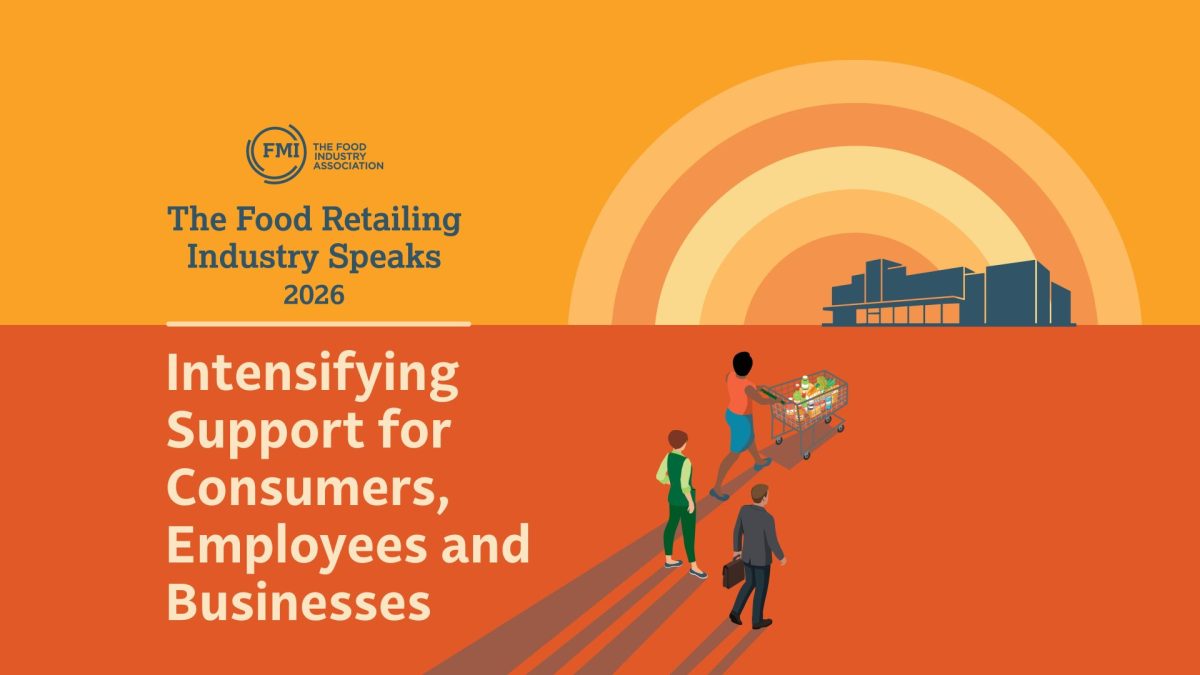
Despite macroeconomic challenges, the food industry is leading in new technology implementation, offering more consumer-friendly in-store experiences and providing more options to help Americans reach their health goals, according to The Food Retailing Industry Speaks 2026 report released by FMI – The Food Industry Association.
“Consumers are increasingly sensitive to both the cost of food and the nutritional needs of their families,” said Leslie G. Sarasin, president and CEO of FMI.
“Our annual industry research shows a food industry responding to this challenging economic climate by innovating and improving the customer experience, while offering more healthy options to customers.”
Food retail profit margins remained thin in 2025, up slightly from the prior year, at 2.1 percent. About 90 percent of responding food retailers and suppliers reported negative impacts from international trade and tariffs, and 82 percent of suppliers shared concerns that economic challenges and inflation would influence consumer shopping behavior.
Two-thirds of food retailers and 70 percent of suppliers pointed to negative impacts from supply chain challenges in 2025. About 11 percent of food retailers posted losses. Credit and debit cards represent 81 percent of all sales, a new high.
“The investment food retailers and suppliers are making to ensure robust grocery shopping experiences is significant,” said Steve Markenson, VP of research and insights at FMI.
“Even with tight profit margins, our research finds food retailers and suppliers are investing in improved store space for key departments, customer service excellence, high-quality fresh foods and local products, as well as technology enhancements with a focus on efficient operations and frictionless grocery shopping experiences.”
The report identifies five key strategies for success: grappling with today’s volatile macro landscape; addressing customers’ needs from health to value; optimizing the shopper experience; tapping into new technologies to fuel progress; and bolstering business resiliency.
On private brands, 76 percent of food retailers leveraged programs as differentiation strategies, and 77 percent focused on community support and ties. Retailers are expanding private brand options as a vehicle for healthier options.
On health and well-being, 76 percent of food retailers focused on nutrition, health and well-being, and 74 percent emphasized products with beneficial nutritional attributes. Seventy-six percent of suppliers focused on products with beneficial attributes for health and well-being, with 67 percent of those suppliers reporting success.
Eighty percent of food retailers now offer online sales – up from about 50 percent before the COVID-19 pandemic – and 94 percent of shoppers purchased groceries both online and in-store in 2025.
Within the store, 82 percent of food retailers surveyed are experimenting with technologies to enhance customer experience. Sixty-seven percent provide curbside pick-up and 58 percent accommodate home delivery.
On technology investments, suppliers spent a greater share of sales (3.3 percent) on technology than food retailers (1.9 percent). Most suppliers (83 percent) expect to increase their technology investments in 2026, and 60 percent of suppliers expect these investments to positively impact their bottom lines.
Methodology
The survey was sent to U.S. and Canadian food retailers, wholesalers and suppliers in February. A total of 70 food retail and wholesale companies completed the questionnaire, supplemented with information from eight public company SEC 10K filings. The survey represents more than 42,000 stores.
About FMI
FMI works with and on behalf of the entire food industry to advance a safer, healthier and more efficient consumer food supply chain.