
Idaho independent’s “Social Deal” program turns Facebook comments into a weekly reservation system – no shopping app to download, no online checkout, no problem.
When Swensen’s Markets posted a deal on 50-pound boxes of Idaho russet baking potatoes to its Facebook page in mid-February, the family-owned grocer likely expected a solid response.
What it got was a flood – nearly 700 comments from customers eager to claim the offer, all following a simple format the store had established – comment “Yes,” list your preferred store location and specify how many boxes you want.
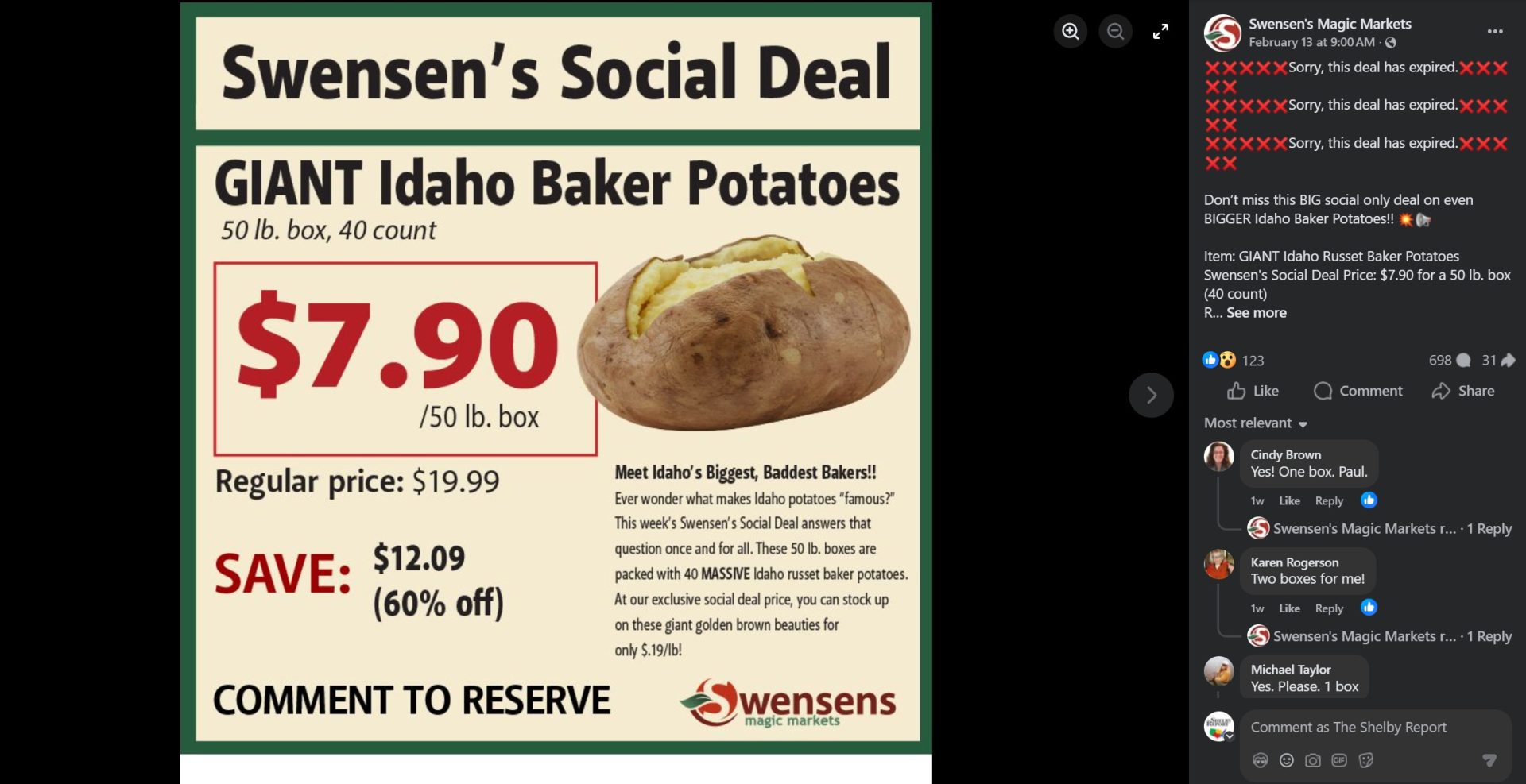
The post, which offered Giant Idaho Russet Baker Potatoes at $7.90 for a 50-pound box (40 count) versus a regular price of $19.99 – a 60 percent discount – was not the result of a lucky viral moment.
It was the latest installment in what Swensen’s calls its “Social Deal” program, a structured, recurring sales channel that the Idaho independent has built from the ground up on its Facebook page, rather than through a dedicated shopping app, an online checkout system or paid advertising.
The comment section read like a steady stream of orders:
“Yes. 1 box. Hagerman. Thank you!”
“Yes 2 boxes Addison.”
“Yes 2 boxes Orchard. Thank you!”
Each comment effectively functions as a reservation. Within seconds of commenting, customers receive an automated confirmation through Facebook. They then pick up their reserved items during a designated window at one of Swensen’s four locations – Orchard, Addison, Paul or Hagerman – with the discount applied at checkout.
Weekly sales engine built on comments
The potato deal, while eye-catching, is just one example. Swensen’s runs Social Deals on a weekly cadence, dropping new offers exclusively through its Facebook page. The store has built what is essentially a subscriber notification list – customers who comment “Yes” or “Deal” on a signup post opt in to receive notifications whenever a new deal goes live.
“Are you getting notified when a new Swensen’s Social Deal drops?” one of the store’s posts reads. “If not, you’re missing out on some incredible savings! Just enter ‘Yes’ or ‘Deal’ in the comments to get started.”
It is a deceptively simple system – at least from the shopper’s side. There are no apps for customers to download, no accounts to create and no credit card information to enter online. From the shopper’s perspective, the entire transaction – discovery, reservation and pickup – happens through Facebook comments and a trip to the store.
The approach taps into what social media marketers call “comment selling,” a tactic that has gained traction in recent years among boutique retailers and direct-to-consumer brands, and that a growing number of software platforms now automate.
While the customer-facing experience runs entirely on Facebook, Swensen’s does not manage the program by hand. The store administers its Social Deals through Commentsell, a comment-selling platform whose AI engine monitors and interprets reservation comments, sends customers confirmations, logs active reservations and helps coordinate in-store pickup. Commentsell, which works with independent grocers and larger supermarket chains across the U.S. and Europe, supplies the automation layer that would otherwise make a weekly, multi-store reservation program impractical for an independent operator to run by hand.
What makes Swensen’s implementation notable is that a brick-and-mortar grocery store is applying the concept to weekly produce and grocery deals – and doing so with remarkable engagement.
Operational advantage
For independent grocers watching from the sidelines, the Swensen’s model offers several practical takeaways that go beyond social media buzz.
Demand forecasting before product hits the shelf – Because customers reserve items in advance via comments, the store knows exactly how many units to allocate for each location before the pickup window opens. With the potato deal limited to 10 boxes per family across four stores, the comment thread essentially functions as a pre-order system.
Guaranteed foot traffic on specific days – The pickup window for the potato deal was limited to Feb. 19-20. Every customer who reserved a box had to walk into the store during that two-day window. For an independent grocer, converting hundreds of online engagements into guaranteed in-store visits on predictable days is a powerful operational tool – particularly when those customers are likely to add items to their basket beyond the deal.
Low technology overhead – The program requires no custom app development, no online checkout build and no paid advertising. Swensen’s runs it through its existing Facebook page and a subscription to Commentsell, which supplies the AI automation that reads comments and confirms reservations. For an independent operator, that combination is considerably less expensive and less complex than building and maintaining a proprietary shopping app.
Built-in virality – Facebook’s algorithm rewards posts that generate high engagement, particularly comments. A post with nearly 700 comments gets pushed into more news feeds organically, extending the store’s reach to potential customers who may not already follow the page. Several comments on the potato deal post included customers tagging friends and family members, further amplifying visibility at no cost.
An Idaho story, through and through
That the viral deal centered on Idaho russet potatoes is no coincidence. Swensen’s Markets is rooted in Idaho’s Magic Valley, with locations in Paul, Addison and Orchard.
The company has operated in the region since the early 1960s, when founder Sherm Swensen opened a small corner market in Twin Falls. Today, the business is still family-owned and continues to emphasize locally sourced products.
Moving 50-pound boxes of Idaho bakers at volume through a social media channel underscores the enduring consumer appeal of the state’s signature crop – and demonstrates that independents can find creative, low-cost ways to drive bulk sales of commodity products when the value proposition is right.
At $7.90 per box, the deal worked out to about 20 cents per potato – a price point that clearly resonated with families in the region.
What other independents can learn
The Swensen’s Social Deal model is replicable. It does not require a large social media following to start, though consistent execution will build one over time.
The key elements are a compelling weekly deal, a clear and simple reservation format, a defined pickup window and a reliable automated confirmation system – the first three a matter of merchandising discipline, the last typically handled by a comment-selling platform such as Commentsell.
The strategy also aligns with broader shifts in how consumers discover and interact with local businesses on social media. A 2024 report from The Packer noted that independent produce retailers are increasingly finding success with organic social media strategies that prioritize authenticity and community engagement over polished advertising.
As one social media consultant told the publication, retailers should focus on identifying what consumers are already paying attention to and creating content that is relevant to those interests.
For Swensen’s, that relevance is built into the deal itself. There is no gimmick, no dance video, no trending audio clip. It is a straightforward value proposition – potatoes at a steep discount, available only to those who engage – delivered through a channel where the audience is already spending its time.
And based on the nearly 700 comments on a single post, the audience is paying attention.
Editor’s note: This article was updated on May 22, 2026, to clarify that Swensen’s Markets administers its Social Deal program through Commentsell, a comment-selling platform with AI-powered automation. An earlier version described the program as running solely on Facebook’s native tools.
This is actually powdered by a software called http://www.commentsell.com