
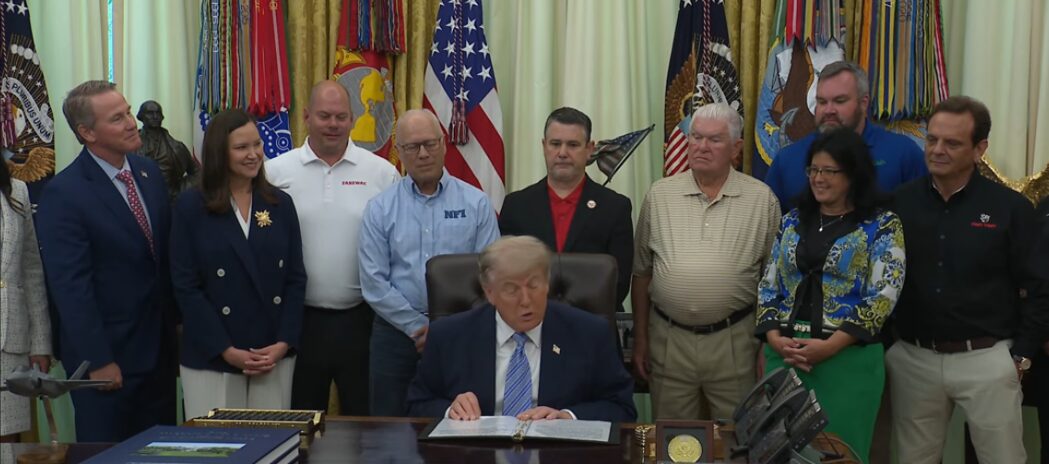
President Trump and EPA Administrator Lee Zeldin announced revisions to two commercial refrigeration rules May 21, drawing praise from FMI – The Food Industry Association and the National Grocers Association (NGA), which said the changes will spare grocery retailers – especially independent operators – from an estimated $144 billion in compliance costs.
The final EPA Technology Transitions Rule and a reconsideration of the Leak Management (or “Refrigeration Management”) Rule affect the commercial refrigeration systems found in grocery stores and refrigerated trucks.
Under the Biden administration, FMI filed a legal challenge to the original Technology Transitions Rule, then worked with the Trump administration to intervene in the litigation and secure reconsideration.
FMI also petitioned the EPA in November 2025 for targeted changes to the Leak Management Rule, including higher coverage thresholds and more realistic leak-rate standards.
NGA: ‘Historic deregulatory effort’ for independent grocers
NGA President & CEO Greg Ferrara released a statement after a group of NGA members joined President Trump in the Oval Office to mark the decision.
“This historic deregulatory effort is a meaningful step toward leveling the playing field for the family-owned, locally rooted businesses that anchor neighborhoods across the country,” he said.
He noted that independent supermarkets operate on net profit margins of just 1-2 percent, leaving “virtually no room to absorb the billions of dollars in refrigeration compliance costs that community grocers were facing before today’s announcement.”
Ferrara went on to call the Technology Transitions Final Rule “a clear example of a one-size-fits-all federal mandate that fails to account for the realities independent operators face.”
He also pointed to the industry’s economic footprint: the independent grocery sector generates more than $557 billion in annual economic activity and supports 1.5 million American jobs.
“Every dollar a small grocer is forced to spend on excessive refrigeration compliance is a dollar that cannot go toward keeping prices low, hiring local workers, upgrading stores, or expanding access to fresh, nourishing food in the communities that need it most,” Ferrara said.
“Cutting unnecessary federal red tape is, in effect, direct relief for American consumers and the families who shop at independent grocery stores every day.”
FMI: Rules threatened $1,000 per household
FMI President & CEO Leslie G. Sarasin issued a separate statement thanking the administration.
“FMI is grateful for EPA’s efforts to prevent an increase in grocery prices by revising the Technology Transitions Rule and reconsidering the Management Rule,” Sarasin said. “Taken together, these actions preserve the agency’s goals without placing unnecessary financial burdens on the food industry and grocery shoppers.”
Sarasin said the original rules imposed significant costs and unrealistic compliance timelines. Economic analysis cited by FMI estimated the two rules together could impose nearly $144 billion in costs on American businesses and consumers.
“Providing grocery retailers with additional time to comply with the Technology Transitions rule and announcing reconsideration of the Management Rule to evaluate ways to make it less burdensome will help address challenges related to upgrading refrigeration systems, including the limited availability of alternative technology, shortages of qualified installers and technicians, and other supply chain constraints,” Sarasin said.
“It will also provide much-needed certainty to stores across the country and help prevent billions of dollars in unnecessary refrigeration premiums that would then have to be passed on to consumers.”