

The leadership lesson this month is part math and part perspective lesson. It’s one of those ideas that, once we truly see it, permanently changes how we think about the grocery business. We may even look back later and realize it was one of those moments that quietly – but decisively – turned the tide in our leadership style.
Over the last few months, we’ve covered some consistent themes:
- Everything rises and falls on leadership.
- Leadership is influence.
- Most lessons in the grocery business are simple math.
- This month’s lesson ties all three together in a practical way. This isn’t theory, nor is it motivational fluff.
It’s about how leaders think. It’s about how leaders decide. And it’s about how leaders treat the company’s money.
Because leadership shows up most clearly in the decisions we make when no one is watching, especially when numbers are involved.
Simple formula for business success
The No. 1 formula for success in business has not changed and I’ve shared it many times: We take care of our team members. Our team members take care of our customers. Our customers reward our shareholders.
This formula works – and only in this order. It always has. But here’s the reality: Great culture without financial discipline doesn’t last. Strong financial results without leadership discipline don’t scale. Both matter.
Data – numbers side of the formula
Those who know me at all know this already – I’m a data freak. And I mean that in a good way.
Data doesn’t replace leadership instinct, it sharpens it. Data doesn’t remove judgment, it informs it.
I validate my thinking and expand my understanding of the business through data. When leaders consistently use data as the foundation for financial decisions, they dramatically increase the odds of making the right call.
Data is the starting point – not the finish line. But it has to be translated correctly. Percentages feel soft. And we don’t take percentages to the bank.
If we don’t know how many dollars a percentage represents, we don’t really know the number we need to focus on.
Lesson from the front end – cashing checks
Early in my career as a store director at United in Oklahoma, we cashed checks in every lane. One of the stores I ran sat right along Interstate 40, which meant we saw people from all over the country driving through.
It was always amazing to me the checks we would accept that looked completely bogus. But we were a customer-driven company, and we didn’t like telling customers no.
The result? We’d sometimes get hit with runs of bad checks – several in a day or across a short stretch of time.
So I gave my management team a simple rule: “If you would pull out your own billfold and cash that check, then cash it. If you wouldn’t – don’t.”
That one sentence changed behavior immediately. Why? Because it forced leaders to mentally convert company money into personal money. Suddenly the decision felt different. Suddenly the risk felt real.
This lesson works great for many of my clients that are ESOP companies – because the reality in that world is that it is in fact your money – so it’s easier to treat it that way.
Same rule applies to buying
Later in my career, when I was leading center store purchasing teams, I’d walk stores and see product that stopped me in my tracks, and I couldn’t believe we bought it to sell. High-dollar items that barely sold. Quantities that tied up cash for weeks or months. Product that looked good on paper but didn’t make sense.
So, I introduced another rule – almost identical to the check rule: “If you’d pull out your own checkbook and write a check for all this product, then it’s probably a good buy.”
Again, behavior changed. Not because people suddenly became expert merchants, but because the decision now carried ownership.
Leadership isn’t just approving purchases; leadership is asking the right questions before the purchase is made.
Danger of percentages without dollars
Here’s where things get uncomfortable. We have leaders responsible for making the company financially successful who lose thousands of dollars through:
- Missed margin
- Excessive shrink
- Poor ordering
- Bad buying
- Missed labor targets
And too often, the reaction is casual. Why? Because percentages don’t hurt the way dollars do.
A half-point of margin doesn’t sound like much until it’s converted to dollars.
Shrink doesn’t sting until we see it on the P&L.
We must always know how many dollars the percentage equals. Always.
Inspect what to expect – everywhere
Think about this. We check in bread vendors at the back door with a fine-tooth comb – every loaf, every discrepancy, every dollar.
Yet we’ll unload a wholesaler’s truck with tens of thousands of dollars of product, assume everything is correct and immediately start working the load to the shelves.
That makes no sense. The issue isn’t trust; it’s discipline. Leadership requires consistency, especially when money is involved.
When margin misses become normal
We’ve all heard it. A department misses margin week after week, period after period. When questioned, the explanations and excuses come quickly:
- “They’re still learning.”
- “They over-ordered and can’t recover.”
- “They’re throwing too much away.”
- “They’re dealing with personal issues.”
- “The weather impacted sales.”
Here’s the leadership question that cuts through all of it: What if this was your money?
If someone dipped into your checking account every week and pulled out thousands of dollars, you wouldn’t rationalize it. You wouldn’t normalize it or wait months. You’d act immediately.
And yet, that’s exactly what’s happening to the company’s checking account every single day. Delayed reactions turn small problems into big ones.
Leadership requires urgency
True leadership creates urgency without panic. It recognizes issues early. It responds quickly. It puts guardrails in place.
Missed margin, poor buying, excessive shrink and labor misses aren’t just operational issues; they are leadership issues. And standards that aren’t enforced eventually disappear.
Weekly challenge
Here’s the challenge– not just for this week, but going forward:
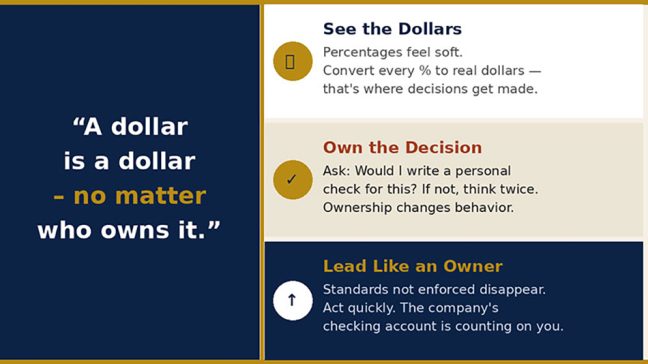
Treat the company’s money like it’s your money, because a dollar is a dollar – no matter who owns it.
If leaders at every level embraced that mindset, the numbers would change. I guarantee it.
Where else does a single store manager or buyer have the ability to influence thousands – or millions – of dollars with no personal financial risk?
Nowhere that I can think of.
That trust is a privilege.
And it carries responsibility.
Rules No. 1 and 5 – The math version
This lesson connects directly to two core leadership rules from my book “The 5 Rules”
Rule No. 1: Do your job (math version). Know the numbers. Understand the dollars behind the percentages. Act quickly.
Rule No. 5: Protect the brand. The future of the brand depends on leaders treating company dollars with the same care as their own.
Every bad buy weakens the brand. Every missed margin erodes trust. Every disciplined decision strengthens the future.
Final thought
Leadership isn’t just about people, although that should always be our top focus; it’s about stewardship.
When leaders think, act and decide like owners, everyone wins – the team, customers and the company.
Remember this: A dollar is a dollar – no matter who owns it.
And how we treat that dollar says more about our leadership stewardship than anything else.
Steve Black is CEO and founder of abrighterday.life, a business and leadership coaching organization devoted to helping people and companies with personal growth and implementing simple leadership principles. A 47-year veteran of the retail grocery arena, Black is the author of “The 5 Rules” and offers an online Masterclass.
[RELATED: Leadership: Prime Time Defined]