
In a previous column, we discussed building businesses to last and some of the factors that influence valuation. Today, we will take a closer look at one area that often creates confusion – the valuation of real estate in the grocery industry.
Nerd alert: This one is a little more technical, but I believe it might help address a concept that impacts us all. Or perhaps to explain it to someone who doesn’t deal with it every day.
The first concept to understand when evaluating commercial real estate is that, unlike a private residence, the value of commercial property is based primarily on its ability to generate cash flow.
There are many beautiful commercial buildings that do not have paying tenants. Their value often is little more than scrap value. Conversely, there are some rather unimpressive buildings connected to strong leases with strong tenants and their value can be dramatic.
Bottom line, commercial real estate is effectively worth the income stream and the likelihood that income stream will continue.
Cap rate method
The generally accepted method for calculating the value of commercial real estate is through the capitalization rate, or cap rate. Understanding this method requires looking at two components: Net operating income (NOI) and the cap rate.
NOI represents the amount of money the landlord receives from the property after accounting for expenses. The cap rate reflects the perceived risk that the income will continue in the future. 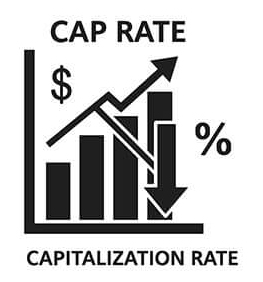
When these two elements are combined, they provide a framework for estimating the value of a property.
NOI is easiest to understand when we are dealing with a true triple-net lease. In this structure, the tenant is responsible for nearly all expenses associated with the property. This typically includes maintenance, repairs, insurance, property taxes and other operating costs.
In such a case, the landlord receives the rent and does not have to pay those ongoing expenses.
If the rent is $100 under a true triple-net lease, then the NOI also is $100. The landlord essentially receives the rent without having to account for additional costs.
However, many leases are not perfectly triple-net. Sometimes the landlord retains responsibility for certain items – perhaps the roof, the parking lot or the HVAC system. Those responsibilities must be accounted for when calculating NOI.
For example, suppose the landlord remains responsible for the roof. The roof was replaced 15 years ago and is expected to last another five years. Even though the roof is functioning well, the landlord knows it will eventually need to be replaced.
To calculate an accurate NOI, the landlord must estimate the cost of replacement and allocate that future expense appropriately. In effect, a portion of the rent must be set aside to cover that expected cost.
If the roof had just been replaced this year, then there are more years to save up the funds for the future expense, and the NOI would therefore be higher. If the roof is older and closer to replacement, more of the rent must be reserved for that future cost, which lowers the effective NOI.
The key point is that NOI reflects the income the landlord can reasonably expect to keep after accounting for the costs associated with owning the property.
[RELATED: Crossroads: The 8 Sales-Building Touchstones]
Understanding cap rate
The second component in this analysis – the cap rate – often is where confusion arises. A simple bit of math can help illustrate the concept.
Consider a fraction. If we place a 1 on top and a 2 on the bottom, we have 1/2, which equals 50 percent. If we place a 1 over a 3, we have about 33 percent. If we place a 1 over a 10, the result is 10 percent.
As the denominator gets larger, the value of the fraction becomes smaller.
In cap rate analysis, we can think of the cap rate as reflecting the level of risk associated with the income stream. A higher cap rate indicates greater perceived risk and that results in a lower property value. A lower cap rate indicates more confidence in the income stream, which produces a higher property value.
In practical terms, investors are willing to pay more for a property when they believe the rent is secure and likely to continue.
Several factors influence where a cap rate falls within the market. One of the most important is the financial strength of the tenant. If the tenant has significant financial resources and the lease includes meaningful guarantees, the likelihood that rent will continue to be paid is relatively high. That stability tends to lower the cap rate.
Another major factor is the structure of the lease itself. Lease terms that protect the landlord – requiring rent payments under most circumstances and limiting opportunities for termination – also tend to reduce perceived risk.
Conversely, leases that provide extensive protections or flexibility for the tenant may increase risk for the landlord and therefore lead to a higher cap rate.
What is typical in grocery industry?
I work with wholesalers and retailers across the country, and a wholesaler once explained to me that the real estate associated with its stores generally averages about an eight cap.
At first glance, this may seem surprising. The company in question is financially strong and has more than sufficient assets to support its operations. One might assume that this strength alone would justify a lower cap rate and therefore a higher real estate valuation.
However, the company also is in position to negotiate lease terms that provide strong protections for the retailer rather than the landlord. Those protections increase the risk borne by the property owner, which tends to push the cap rate higher and the valuation lower.
This example illustrates the balance that often exists in grocery real estate.
If a retailer has weaker financials, the value of their lease – and therefore the value of the property – may decline. On the other hand, lease terms that strongly favor the landlord may offset some of that risk.
In practice, when we see low cap rates, it may indicate not only that the tenant is strong but also that the landlord has negotiated lease terms that favor them.
[RELATED: Crossroads: Built-To-Last Factors Impacting Value]
Perspective matters
It also is worth remembering that perceptions of risk and strength vary depending on who is doing the talking.
A landlord who is selling real estate – or presenting it to a bank for financing – will naturally emphasize the strength of the tenant and the security of the lease.
Sometimes that perspective reflects genuine optimism and other times it reflects negotiation strategy.
If you are the retailer tenant and comfortable with the lease, you may be pleased that the landlord can sell the property at a higher price or obtain favorable financing.
However, a sophisticated buyer who purchases the property will analyze the lease closely. If he believes the cap rate paid requires stronger protections, he may attempt to renegotiate terms.
For those trying to estimate the value of grocery real estate – whether to own, buy or occupy – it often is reasonable to assume that an eight cap is somewhere in the expected range when there is a solid tenant and lease terms that favor the grocer.
If advisors or transaction professionals suggest a much lower cap rate – perhaps a six or even a five – it may be wise to review the lease terms carefully. Lower cap rates often indicate that the landlord has secured favorable protections.
Conversely, tenants with weaker financial positions or unusually strong lease protections often will result in cap rates higher than eight.
When owners wear two hats
Many of these negotiations involve separate parties. The tenant negotiates the lease, while the landlord negotiates with buyers or banks regarding the value of the real estate.
Understanding the mechanics of NOI and cap rates allows participants to better understand the motivations and strategies of the other parties involved.
This becomes particularly important when the same person or family controls both the real estate and the grocery operations. Increasing the rent or strengthening the lease terms, for the benefit of the landlord will increase the value of the real estate, while at the same time reduce the value of the operations because of the drain of those extra expenses.
These questions become more complex in family businesses. Sometimes the real estate is transferred to one family member while the operating business is transferred to another. Lease terms, valuations and financing arrangements all can influence the long-term relationship between those parties.
Understanding how these pieces fit together can help families make decisions that support both financial success and healthy relationships. Because at the end of the day, that is often where the most important decisions take place – at the crossroads of business and family.
Carey Berger is president of Business Service Resource Group.
[RELATED: Crossroads: Where Life And Business Meet]