
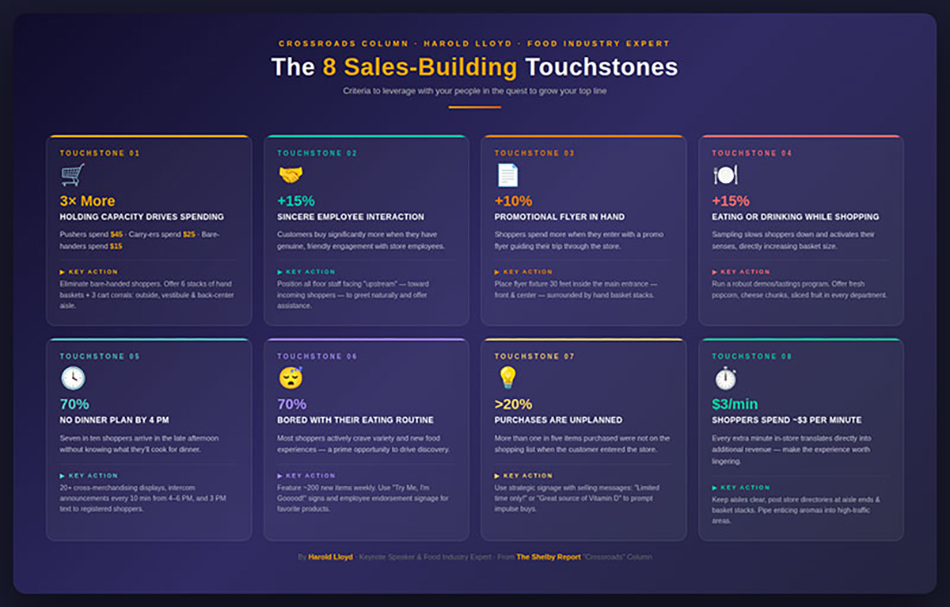
For the third article in our ongoing column dedicated to long-term success over the generations, we have invited keynote speaker and food industry expert Harold Lloyd to share his thoughts on some of the many ideas to help increase the top line of your ongoing business success and value.
The most obvious influences on a company’s EBITDA are sales and expenses. But much of the focus at recent supermarket conferences and conventions has been on artificial intelligence software apps, ChatGPT and a dozen other initial-based topics.
While it is essential to stay abreast of the innovations that will drive our future, we must not overlook the basics behind building sales within the four walls of our stores.
Although supermarket management is not rocket science, it is a “science” – and one to be studied. That’s exactly what I have done for more than 40 years. Here are my most relevant findings. I call them “8 Sales Building Touchstones.”
A touchstone is a criterion, standard or benchmark. These eight touchstones are criteria for us to leverage with our people in the quest to grow our top line.
The greater the customer’s “holding capacity,” the more they buy.
Actions: First determine the percent of shoppers who push, carry or “bare hand” it. Work as a team to eliminate all bare-handed shoppers, converting them to “pushers” or “carry-ers.” Then, convert as many “carry-ers” to “pushers.”
A “pusher” spends $45, a “carry-er” spends $25 and a bare-hander about $15. Do the math. Additional actions to take include offering three cart corrals – outside, in the vestibule and a smaller corral in the back-center main aisle.
Accomplished merchandisers typically see many customers walking around with more than they can carry. Offer them convenient alternatives; six stacks of hand baskets and three cart corrals.
The customer buys 15 percent more when they have sincere employee interaction.
Actions: Position all employees working on the sales floor to face “upstream.” Too often employees inadvertently put their backs to the customer. A frontal view is infinitely more inviting than a backside. It’s also easier to greet a passing customer and offer assistance.
[RELATED: Crossroads: Built-To-Last Factors Impacting Value]
Customers buy 10 percent more when shopping with a promotional flyer.
Actions: Don’t hide those in-store promo flyers on a rack stuck in a corner of the lobby. Front and center, 30-feet inside the main entrance is the ideal location. And surround the fixture with stacks of hand baskets.
Customers spend 15 percent more when eating or drinking something.
Actions: A robust tastings (demo) program is an effective way to leverage this touchstone.
In the absence of that, frequent, attractive samplings in each department are a great alternative. Offering fresh popped popcorn, cheese chunks, sliced kiwi, etc., will slow shoppers down and tickle their taste buds.
At 4 p.m., 70 percent of shoppers do not know what they will have for dinner.
Actions: Offering 20-plus creative and inviting cross-merchandising displays on an ongoing basis is a home run. So is an intercom program with announcements every 10-minutes from 4 to 6 p.m. Also, an inviting 3 p.m. text message sent to all registered customers would effectively keep the store at the top of their minds when it comes to deciding what’s for dinner.
Seventy percent of shoppers say they are bored with what they are eating at home.
Actions: A storewide program featuring some 200 new items each week will go a long way toward keeping store assortment looking new.
“Try Me, I’m Gooood!” signs will be a welcome sight for bored shoppers. Also, many clever merchandisers use employees as sales influencers by endorsing their favorite products with personalized signage.
Over 20 percent of all supermarket purchases are unplanned.
Actions: Signs often are boring, with minimal wording. The item name and price dominate. Without cluttering up the sign, strategic selling messages can go a long way to bolstering the sales of an item.
Signs stating, “Limited time only!” or “Great source of Vitamin D,” give shoppers a compelling reason to add that unplanned purchase to their baskets.
Shoppers spend nearly $3 per minute while shopping.
Actions: Maintaining uncluttered aisles, offering easily accessed store directories on the ends of each grocery aisle and by each handbasket stack, makes good sense when attempting to capitalize on this touchstone.
So does piping aromas into high-traffic areas. Shoppers will absolutely stay longer and buy more when they are overwhelmed with smells.
These suggestions will hopefully provide a start in the right direction. Please email me success stories and how these touchstones were applied. Good luck!
Lloyd can be reached at [email protected] or (757) 572-7276.