

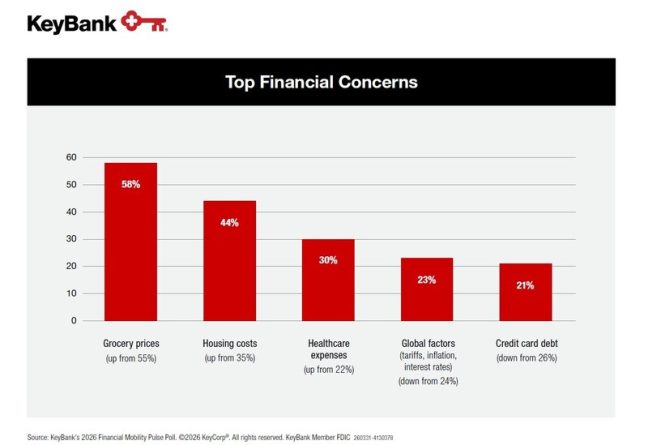
Nearly nine in 10 Americans have made at least one meaningful adjustment to their financial behavior in response to economic pressures, with grocery prices ranking as the No. 1 concern, according to KeyBank’s 2026 Financial Mobility Survey Pulse Poll.
The survey of 1,000 Americans ages 18-70, conducted by Schmidt Market Research in January, found that 58 percent of respondents cited grocery prices as their top financial concern – well ahead of housing costs (44 percent) and healthcare expenses (30 percent). Healthcare was a notable mover, climbing from 22 percent in 2025.
“The financial pressures people face today are real and widespread across the financial spectrum. What stands out, though, is that Americans aren’t waiting for conditions to improve,” said Daniel Brown, EVP and director, consumer product management at KeyBank.
“They’re being proactive and resourceful in response to these pressures, and these aren’t just one-time reactions – 88 percent of Americans have made at least one meaningful adjustment to their finances. People are navigating the current economic climate through daily decisions that are quickly becoming lasting habits.”
The data carries direct implications for grocery retailers. The most common consumer response to financial pressure is switching to less expensive brands or services, cited by 59 percent of respondents – up from 49 percent in 2025. That 10-point jump signals continued momentum for private label and value-tier products across the store.
Other top strategies include cutting subscriptions or memberships (51 percent, up from 41 percent) and reducing discretionary spending (11 percent, up from eight percent). More than one in three Americans (35 percent) has taken on additional work to generate supplemental income, with Gen Z leading at 49 percent.
Financial trade-offs have become a daily exercise for many households. One-third of Americans report making financial compromises every day, and another 31 percent do so weekly. Even higher earners are not exempt — 26 percent of those with household incomes of at least $100,000 make daily financial trade-offs.
Consumer optimism is softening across all income levels. Only 20 percent of Americans described their personal financial outlook as positive, down from 26 percent in 2025. Among households earning $100,000 or more, optimism dropped to 29 percent from 34 percent. Millennials saw a decline to 23 percent from 28 percent.
The poll is a follow-up to KeyBank’s Financial Mobility Survey conducted in July 2025. The full executive summary is available at key.com.
KeyBank (NYSE: KEY), headquartered in Cleveland, is one of the nation’s largest bank-based financial services companies with about $184 billion in assets and roughly 950 branches across 15 states.
[RELATED: Study Finds Food Affordability Rivals Taste As Top Purchase Driver]