
Americans filling Easter baskets this year are getting far less candy for their money than they were six years ago, according to new research from InvestorsObserver.
A review of five popular Easter candies sold at a major national retailer shows prices have risen 67 percent since 2020, while average household Easter candy budgets have grown only about 15 percent over the same period. The result: a family of four spending the same roughly $93 Easter candy budget as in 2020 now walks away with about 40 percent less candy by weight.
To buy the same amount of candy purchased in 2020, a household would need to spend approximately $155 in 2026 – a $62 increase for the same product volume.
“It’s the classic boiling frog scenario that shows up in groceries year-round,” said Sam Bourgi, senior analyst at InvestorsObserver. “You don’t jump out of the pot because the water heats up one degree at a time. Each individual increase feels tolerable – annoying, maybe, but not catastrophic. So you adjust. By the time you realize how hot the water has gotten, you’ve lost significant purchasing power.”
Incremental Increases, Major Impact
The disconnect stems from how price increases accumulated. Year-to-year changes appeared moderate – 0 percent in some periods, 12 percent in others – but the cumulative effect has been significant. Between 2020 and 2026, the average price per ounce across five tracked Easter candies rose from $0.37 to $0.62. 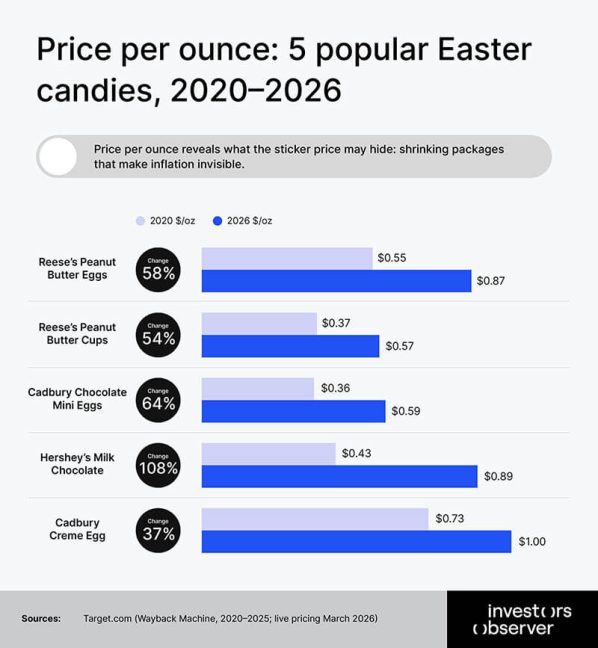
In 2020, Easter candies ranged from $3.49 to $3.99 – a tight window that made it easy to spot a good deal. By 2026, that range had expanded to $4.79 to $8.29, making it harder for shoppers to gauge what is reasonable.
The USDA predicts prices for sugar and sweets will increase 9.8 percent in 2026, with candy and chewing gum among the categories experiencing the largest price hikes.
Shrinkflation Also a Factor
The Easter aisle did not escape shrinkflation. Cadbury Mini Eggs shrank from 10 oz. to 9 oz. in 2022 with no change in price, meaning shoppers paid the same for less product.
The Hershey’s Milk Chocolate bar stands out as the most extreme case in the research, with a 107.8 percent price-per-ounce increase. The package size never changed – shoppers received the same 1.55-ounce bar throughout – but the price climbed from $3.99 in 2020 to $6.39 by 2022, then dropped to $5.49 in 2024 before jumping to $8.29 in 2025, surpassing all previous levels.
“When a price drops and then spikes even higher, it feels more unfair than a steady increase,” Bourgi said. “The drop resets your expectations – you think things are getting better – which makes the spike feel manipulative rather than market-driven.”
The research tracked five top-selling Easter candies from 2020 to 2026 using Target.com prices sourced from the Wayback Machine and current listings, selected based on Instacart bestseller data. Household budget impact was calculated using the National Retail Federation’s $23.30 per-person Easter candy spend figure from 2020. Key limitations include single-retailer pricing and potential gaps in archived promotional data.
[RELATED: NCA Launches Candy Campaign Ahead Of U.S. 250th Anniversary]