

Grocery Outlet’s top executive was candid in his remarks to the investment community during the grocer’s earnings call March 4.
Jason Potter, who took over as president and CEO of Emeryville, California-based Grocery Outlet in February 2025 after nearly five years as CEO of upscale retailer The Fresh Market, said, “I joined Grocery Outlet because I believe in what makes this business special – a uniquely differentiated model that provides tremendous value to customers with opportunities to scale.
“One year into my time here, I believe in those things more than ever, but I want to be direct with you today: Our fourth-quarter results were unacceptable, and our outlook for 2026 reflects a business that has more work to do than we expected,” he said. “I own this and own fixing the issues. Today, we plan to provide an explanation of how we got here, where we are and what we’re doing about it.”
The biggest immediate change – in response to lower comp store sales and operating and net losses – is the closure of 36 stores, primarily in the company’s East division, that will take place before the end of the second quarter.
A total of 24 stores will close in four states: Maryland (8), New Jersey (6), Ohio (6) and Pennsylvania (4).
The remaining 12 are in southern and central California (9) and Idaho (3).
Potter said the company conducted a rigorous analysis of its store fleet, which led to the difficult conclusion that those 36 stores “did not have a viable path to sustain profitability, regardless of the operational support we could provide,” he said.
After the closure of the 24 stores in the East – representing about 30 percent of that region’s stores – Grocery Outlet will have 51 profitable stores in the region that recorded comparable store sales increases of 3.3 percent in the fourth quarter, “which gives us confidence in the core health of the go-forward portfolio,” Potter said.
“We are not fully exiting any state, and we believe we have a meaningful opportunity to grow in the East over the long term,” he added. “However, it’s clear now that we expanded too quickly, and these closures are a direct correction.”
Once these stores are shuttered, the grocer will be profitable in each of its markets, Potter said.
The closings also are expected to result in an annualized adjusted earnings before interest, taxes, depreciation and amortization (EBITDA) improvement of about $12 million, he said.
“Just as importantly, closing these stores will free operational capacity and focus that we will redirect toward our model refresh rollout of the 150 stores this year,” he added.
Grocery Outlet and its subsidiaries currently operate more than 500 stores in California, Washington, Oregon, Pennsylvania, Tennessee, Idaho, Nevada, Maryland, Ohio, New Jersey, North Carolina, Georgia, Alabama, Delaware, Kentucky and Virginia.
Just over two years ago, Grocery Outlet announced its purchase of United Grocery Outlet, a deal that included 40 stores and an Athens, Tennessee, distribution center, giving the grocer entrée into the Tennessee, North Carolina, Georgia, Alabama, Kentucky and Virginia markets.
Grocery Outlet now is conducting a strategic review of UGO as part of its scrutiny of “every aspect of the business to remove distractions and improve shareholder value,” Potter said.
In response to an analyst question on the earnings call, he said of the UGO review, “we’re re-evaluating the organizational impact that would be required for a full integration of that business relative to the anticipated benefit.”
How they got here
For context on the fourth-quarter results, which saw a 0.8 percent decline in comparable store sales, Potter went over impactful events from the past six months. 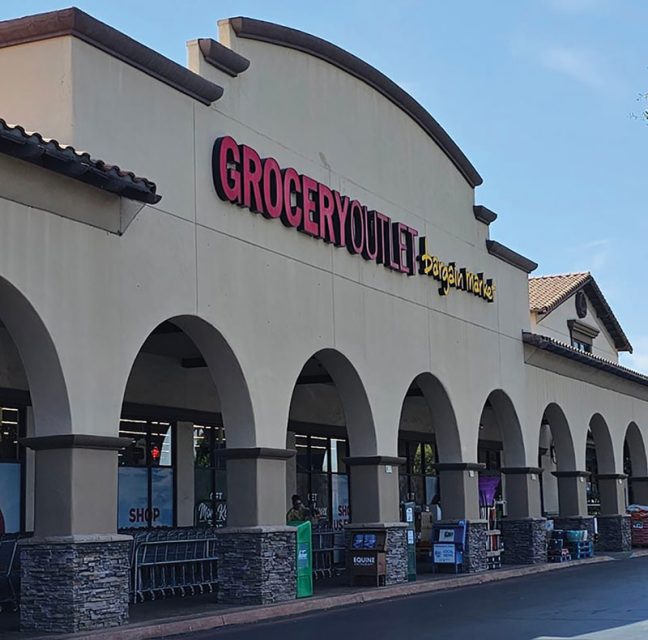
In August, when the company was reporting second-quarter results, the company had reason for cautious optimism, he said, as it had delivered three consecutive months of comparable store sales improvement.
“We’d been focused on improving value by sharpening our KVI-based pricing, reversing missteps that occurred in ’24 and believed that this had been a key driver in holding value back for our customers,” he said.
Gross margins were stable because of shrink improvements, and the new stores that had opened in 2025 were performing better than expected. Future growth plans were “modulated” to prioritize return on capital, and “finally, we believed that restoring key operator tools from our systems work, like the real-time order guide and new arrival guide, would create an immediate tailwind to store productivity,” Potter said.
But, as the company noted during its third quarter earnings call, comp performance began to deteriorate in late September, at least partly due to marketing decisions that were net-negative, “and we responded by recalibrating our marketing mix and doubling down on in-store execution.”
With new leaders installed in store operations, merchandising and supply chain, Grocery Outlet at that point began accelerating its store refresh program, as early results had been encouraging.
But weak November comps followed, driven in part by the timing of SNAP benefits distributions that negatively impacted the business. In addition, “affordability pressure on our core customer increased more than we’d expected,” Potter said.
With basket pressure just getting more intense, comparable store sales continued to decelerate in January, driven by declining units per transaction and slowing traffic growth, he said.
Those realities drove the company to take “a hard look at the business from end to end – buying and supply chain, pricing and promotions, the customer experience and our store network. We also sourced feedback from our customers and our operators. This deep review surfaced three fundamental drivers of comp deceleration,” Potter said.
First was intensified consumer pressure.
Second, as revealed by customer surveys and third-party research, Grocery Outlet’s “base pricing was competitive, [but] our leadership position on value perception had eroded,” Potter said. “While we made progress by addressing KVIs, we needed to address value more holistically.”
Third, the company’s push to improve in-stocks and add assortment to ensure the availability of everyday items squeezed the supply chain, “impacting our ability to deliver high quality, opportunistic product that drives value” in the business.
“Shoppers came in looking for the value and the treasure hunt experience they expect from Grocery Outlet but left with fewer items per trip because we didn’t deliver the weight of ‘wow’ items and the breadth of assortment that drives basket size and value,” he said.
What’s next
In addition to the store closings to improve profitability, the company is in the process of restoring its opportunistic product mix.
“Grocery Outlet has historically delivered extreme savings by providing tremendous deals on opportunistic product,” Potter said. “Our customer’s perception of value is driven by our opportunistic product, and they describe these products as great deals or promotions, with discounts up to 60 percent across an ever-changing and wide breadth of branded, high-quality assortment.”
He added that the company believes there is ample supply of opportunistic product to be found, and that Grocery Outlet is in “constant contact” with its major suppliers to find them.
He said over the next several months the Grocery Outlet team will be “intensely focused on ensuring we have the right weight and depth of quality opportunistic-branded product flowing into our mix to restore a winning position on value with our customer.”
The grocer has made room in its distribution centers for additional opportunistic products by reducing inventory of non-productive categories; improved its internal forecasting to maximize opportunistic buying; and improved communication and the “internal planning horizon” to give store operators more time to plan effective opportunistic product execution, Potter said.
He said the number of “opp” products already has begun to grow again, and as that process continues, Grocery Outlet is investing in promotions on branded and fresh product to generate excitement among shoppers.
“We began these investments in early February, and comp performance has improved by roughly 100 basis points month over month relative to January,” Potter said. “That’s an early data point – not a declaration of victory – but it tells us the customer is responding positively.”
In January, the company’s merchandising and purchasing functions were unified under Matt Delly, who Potter described as “a strong and experienced leader … who’s focused on delivering stronger collaboration and organizational agility with a specific focus on opportunistic offerings and supplier engagement.
“These changes are designed to ensure we’re consistently doing what we do best – providing extreme value for customers across a wide range quality, branded product that drives comp sales and strong margins.”
Store refresh program rolls on
During Grocery Outlet’s third-quarter earnings call in early November, Potter related the company’s store refresh plans designed to improve the store layout; expand and standardize the core product assortment; and elevate the company’s value messaging through signage.
All of these moves were designed to ensure that shoppers could do their full-basket shop each trip while also finding “treasure” in the aisles.
He said at the time that 20 stores would be refreshed by the end of 2025, and another 150 or so by the end of 2026.
Both operator and customer feedback in recently refreshed stores have been “consistently positive,” he said, adding that early data from the stores shows “encouraging comp lifts” versus a control group.
“As we’ve scaled, our understanding of what’s working commercially and operationally is helping us continue to strengthen execution as we expand our rollout,” according to Potter. “These results give us confidence and conviction to move forward with the 150-store target by the end of this year.”
To help the company’s independent store operators (IOs), improvements have been made in item-level inventory management for produce and meat to better align fresh inventory with demand. Those capabilities will be expanded to other categories later this year, Potter said.
He said progress also has been made in giving IOs improved comparability and exception reporting so they can more quickly see and react to opportunities to improve specific underlying business performance.
“Supporting our operators also means we’re making investments in field personnel and support to improve forward planning and communication,” Potter noted.
“While these efforts have driven recent improvement in operator engagement, we are yet to see this translate into increased comp growth. However, we remain convinced that as we fine-tune our value perception with customers and our opportunistic mix, improved operator tools and support will serve as a tailwind.”
A look at the numbers
A metric of great concern is comparable store sales, which were down 0.8 percent in Q4. CFO Chris Miller, speaking during the earnings call, went over the results in depth.
Fourth quarter net sales increased 10.7 percent to $1.22 billion and included an incremental $82.4 million from a 53rd week in 2025. Excluding the extra week, net revenue increased 3.2 percent, driven by the addition of net new stores, partially offset by an 80-basis-point decline in comparable store sales, Miller said.
“The decline in comp, which excludes sales from the extra week, was owed to a 170-basis-point decline in average transaction size, offset partially by a 90-basis-point increase in traffic,” Miller said.
Reiterating Potter’s comments, Miller added, “We believe several factors contributed to the comp decline, including our emphasis on driving better in-stocks for everyday items, which came at the expense of delivering the compelling value items our customers expect, as well as macro factors, including the impact of the U.S. government shutdown on federally funded benefits, as well as a more promotional environment.”
Operating loss in the fourth quarter was $234.8 million, which included $110.2 million in non-cash impairment of long-lived assets and $149 million in non-cash goodwill impairment. Net loss was $218.2 million, or $-2.22 per diluted share, compared to net income of $2.3 million, or $0.02 per diluted share last year.
Seven new stores opened in the fourth quarter.
For the year, net sales increased 7.3 percent to $4.69 billion, and comp-store sales increased 0.5 percent on a 52-week basis. Operating loss was $221.7 million, which included $113.8 million in non-cash impairment of long-lived assets, $45.9 million in restructuring charges and $149.0 million in non-cash goodwill impairment.
Net loss was $224.9 million, or $-2.30 per diluted share, compared to net income of $39.5 million, or $0.40 per diluted share last year.
A total of 42 stores were added over the course of fiscal 2025, and five were closed. The grocer ended fiscal 2025 with 570 stores in 16 states, Miller said.
New store plans
Potter said the store closings are not an indication that the company won’t be opening new stores. They are a portent, however, of a change in strategy. 
“These closures do not change our long-term view that ample white space remains ahead of us, and we continue to plan to open another 30 to 33 net new stores in 2026,” Potter said. “But they do reflect a more disciplined approach. Going forward, we plan to expand with a more clustered model to improve supply chain efficiency and marketing leverage.
“We’re also adjusting how we go to market. We’re piloting new approaches to store openings to strengthen returns on capital. For example, as we launch our stores in Virginia in ’26, these locations will start as company-run, with the intent of bringing them up to profitability before handing them over to independent operators. Once proven, we believe this approach could be applied in more markets as we continue to grow this business.
“The decisions we’ve already made earlier this year to underwrite stricter standards has also strengthened our outlook for our ’26 cohort of new stores, which are now projected to deliver an IRR in the 25 percent range, and the ’27 cohort is now projected to deliver an IRR of up to 30 percent, up significantly from our projections just a year ago,” he said.
Bottom line
“I want to close by being straightforward about where we stand,” Potter said at the end of his prepared remarks. “We haven’t delivered the results that our shareholders, our operators or our customers deserve, and I take responsibility for that.
“What I can tell you is that we have a clear understanding of the commercial challenge, and we’re taking decisive action. We’re prioritizing restoring value perception for our customers. We’re rebuilding the opportunistic pipeline that defines this brand, and we’re reinvigorating the shopping experience in our stores.
“We’re seeing early, tangible signs of progress, and at the same time, we’re eliminating distractions – including closing underperforming stores – and reallocating resources to deliver stronger operating results and return on capital.
“The road ahead will require patience, and we understand this is difficult given the recent results.
“We will be measured by what we deliver, not by what we promise, and we intend to earn back your confidence through execution. We’re confident that we have the right plans in place and the right team to execute them, and I look forward to sharing more about the progress we’re making in the months ahead.”
[RELATED: Grocery Outlet To Close 36 Stores Due To $224.9M Net Loss In Fiscal 2025]