

The National Rural Grocery Summit will be held May 5-7 in Fargo, North Dakota.
The event was created by the Rural Grocery Initiative out of Kansas State University, with the first summit held in 2008 in Kansas. Since then, the summit has grown to attract rural grocers, community leaders, food suppliers, academic researchers, healthy food access stakeholders, policymakers and funders to connect and share experiences.

Rial Carver, program leader for the Rural Grocery Initiative, recently spoke with The Shelby Report about the upcoming event. She said the decision to hold the summit in Fargo stems from partnerships with the University of Minnesota Extension and the North Dakota Association of Rural Electric Co-ops, which are co-hosts this year.
“These are both organizations that have long-standing, robust programs to support rural grocers,” Carver said. “From the start, we knew that they would have a network to pull from in terms of promoting the events and ensuring that rural grocers get to the event.”
North Dakota and Minnesota also are places of innovation in rural grocery, Carver said. She cited the Rural Access Distribution Co-op in North Dakota and the 24/7 unstaffed grocery store model that originated in Minnesota as examples.
The RAD Co-op “exemplifies an effective community-based response to alleviate food sourcing challenges faced by many rural grocery stores,” according to the RGI. “Through the RAD Co-op, member stores purchase collectively from suppliers, ensuring better pricing and more diversified product offerings.”
The 24/7 unstaffed model, which began in Evansville, Minnesota, operates “like a gym,” Carver said. Members have a key code to enter the store, where they shop and pay for their purchases.
“In small towns, that model has proven very useful to address staffing concerns but also without limiting the availability of the store to the community,” Carver said.
She said the concept came from someone driving home from work after regular business hours who passed through several small towns where all the grocery stores were closed.
“He was looking for something to either pick up to take home and make dinner or something to eat on the road,” Carver said. “Nothing was available. So, he came up with this idea for people to be able to check themselves out on their own.”
As the idea has spread, other customer groups have emerged.
“In one community in Nebraska, there were police officers who had no place to go to get a drink [or snack] when they were working the night shift,” Carver said. “We don’t think that end-user was in mind from the beginning, but it really does have applications beyond what was initially brainstormed.”
These are two examples of the models to be highlighted during the summit. Free, planned tours include stops at these and other locations in the region.
History
The Rural Grocery Initiative has been in operation since 2007.
“Our goals are to sustain locally owned, independent grocery stores,” said Carver, noting that the first summit was held to share results of RGI’s initial rural grocery survey.
After that first event, RGI began hosting the summit every other year. According to Carver, attendance has grown from about 50 to 250-300, drawing participants from more than 30 states.
At the 2022 summit, organizers began looking for opportunities to move the event to different locations in the U.S., motivated in part by the addition of tours.
“We wanted the opportunity to highlight these innovative models that are happening in other parts of the country, and what better way to do that than to bring everyone interested in the topic together to see them?”
In 2024, the summit was held in Birmingham, Alabama.
“We were really pleased to partner with Jimmy Wright and with Auburn University’s Hunger Solutions Institute to host our first event outside of Kansas. We heard a lot of positive feedback,” Carver said.
“As we started thinking about 2026, we started to have some conversations with Minnesota and North Dakota and realized there were some opportunities with the innovative models that we’d be able to highlight, as well as the network that they brought to the table and brought to the planning process.”
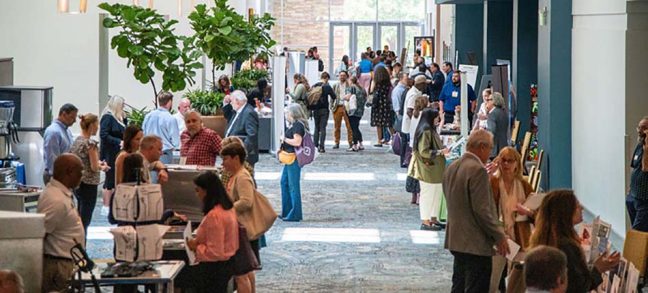
Over recent summits, a format has emerged of keynote speakers, breakout sessions, an exhibitor fair and an evening reception. The fair, reception and break times are designed to facilitate networking, Carver added, “whether it’s networking among rural grocers or the chance for rural grocers to talk to key resource providers, or even just share ideas and brainstorm about what’s going on in their community.”
While rural grocers are the primary audience, the summit also draws other groups.
“We encourage rural grocers to come because, inherently, [they] are fairly isolated geographically and physically … We see the benefit of getting [them] together in one place as really important.”
Another audience group includes community leaders who have identified a challenge related to rural grocery in their towns “and they’re wanting to see what they could do to address it,” Carver said.
“This could be someone who lost a store or is trying to open a store. Or maybe there’s some project that a current owner is looking into, but they work really closely with their economic development partner … and so a community partner is coming to the event on their behalf.”
A third group includes support organizations that she said “lift up rural grocery – funders, economic developers, distributors, researchers, nonprofits. There really is a wide spectrum of interest in rural grocery because it touches on food and health and community vitality. There’s a lot of people from a lot of different walks of life that are interested in this topic.”
Agenda
Two of the four keynote speakers have been announced for the May summit.
Jon Steinman, a food systems thinker, author and educator, will deliver the opening keynote, “More Than a Grocery Store.” Rebecca Undem, founder and executive director of Growing Small Towns, will give the closing keynote, “Grocery Stores as Community Hubs.” The remaining keynotes will address transition planning and legislative efforts supporting rural grocery.
Also on the agenda are four tours: Innovative Grocery and Up North, taking place in Minnesota; and North Dakota Grocery and Fargo Area.
The summit will address perennial challenges rural grocers face, including energy efficiency, equipment upgrades, funding opportunities and transition planning.
Carver said while transition planning has been covered at previous summits, she is looking forward to having it featured in a keynote.
“I’m excited to be elevating that conversation to a higher level,” she said. “The Rural Grocery Initiative in particular has done a lot of work on trying to develop resources to support succession planning for rural grocers. That challenge is not going away, and I’m glad to talk about it.”
New this year will be conversation around food as medicine, with breakout sessions highlighting work related to that topic.
Also new will be a session on fair pricing.
“I think that’s another topic that’s been pretty hot recently and has received some attention, so I’m glad we’ll be able to highlight that with a rural grocery lens.”
Carver added there will be opportunities during the exhibitor fair and poster session “to lift up some of the challenges that may not be addressed in session topics.”
Rural vs. urban
Asked about the differences between rural and urban grocers that make a dedicated summit necessary, Carver said supply chain is a major factor.
“I think for rural grocers, often the choices for supplying the store are relatively limited,” she said. “Some small-town grocers might be working without a distributor, or they might be doing something like we’ve seen at the RAD Co-op, where they’re partnering with other local grocery stores to access competitive pricing. I think that sort of creative thinking and willingness to partner is unique to rural grocery.”
She added that many of the small-town grocers RGI works with feel different from urban or suburban stores.
“There’s some connection there that rural grocers are able to build off of – just recognizing that a rural grocery store in North Dakota can relate to a rural grocery store in Kansas in a way that they might not be able to relate to a suburban or urban store in their same state,” Carver said.
She also pointed to the lack of economic development resources in many small towns.
“I think access to resources or support organizations is sometimes few and far between, and so consolidating all of that in one place and having the funders in the room that work in rural communities, or having the distributors in the room that work with rural stores, helps a grocer to answer a lot of questions at once and hopefully gather contacts that they can then utilize down the road.”
UNFI, KeHE and Natural Choice Foods will be among the wholesalers and distributors in attendance this year.
“We tend to have a decent selection of wholesalers that are there, and often they are participating in the exhibitor fair and sharing some of the resources that they have available through their own programs with the rural grocers that are walking through the event space.”
Kansas City-based AWG has been a past sponsor and remains a strong partner of the Rural Grocery Initiative, Carver noted.
Summit evolving
The competitive landscape facing rural grocers has shifted considerably since the first summit, Carver said. The addition of tours has been a well-received development.
“Being able to dispel any initial misgivings about a potential model, being able to see it in action, I think goes very far,” she said.
The dollar store category has emerged as a significant pressure point.
“The discount or the dollar store has really gained momentum during that time. And for many summits now, there’s been some sort of conversation around dollar stores and how that affects rural grocery, so that’s been a topic that has evolved as the need has evolved,” Carver said.
Policy-level topics also have taken on greater prominence.
“Some of these topics related to policy and fair pricing and food as medicine, and even credit card processing fees – those sort of policy-level decisions, I think, have been coming up more and more at the event and related to the summit,” she said.
Reason to attend
For grocers who may be on the fence, Carver said the opportunity for connection is the summit’s most compelling draw.
“I really think it’s the opportunity to connect with other rural grocers and to feel a sense of camaraderie … I think this event provides the opportunity to connect and even build relationships that you can sustain beyond the event. I hope that rural grocers make the effort to attend,” she said.
Travel scholarships are available to help offset attendance costs. Kansas and North Dakota both have funding for rural grocers, and Minnesota also may have funds available, Carver noted.
Most out-of-state attendees tend to fall into the resource provider category, often traveling on behalf of their organizations. Carver expects strong regional turnout from North Dakota, Minnesota and Kansas, alongside broad national representation.
“By moving it around, we hope that over the course of all of our summits, we’ll be able to be within reach of rural grocers across the country,” she said.
A niche – and a community
The Rural Grocery Initiative is unique in its singular focus on rural grocery, though it is not without partners, Carver said. “Being based out of Kansas, a lot of our work is focused on Kansas and the Midwest. But through this summit, we extend our effort beyond this state.”
She went on to say that the organization is unique in its focus on rural grocery, but there are other entities that have programs related to rural grocery.
“Some have been our co-hosts, or are our current co-host for the National Rural Grocery Summit,” she said, citing Minnesota Extension, the North Dakota Association of Rural Electric Co-ops and the Hunger Solutions Institute.
“They’re kind of our primary target for identifying potential future locations,” Carver added.
Those partner organizations also reflect the collegial atmosphere the summit has cultivated over the years.
“For many of the resource providers that are working to support rural grocers, this is a bit of a reunion for that group, because it is a niche and so it’s always just a really friendly group, social group, and just a fun time to get together,” she said.
Carver said ideas and contacts top the list of what attendees will take back to their communities.
“I hope they’ll leave with ideas to utilize in their communities and contacts to call on in the interim. If they go back home and, in a year, something related to this summit comes up, I hope they’re able to follow up on that lead and build off of that momentum.
“I also think it just leaves them energized. I think getting many rural grocery advocates in one place together really helps to show everyone there that creative thinking and optimism exist in these rural grocery stores, and there’s a lot of opportunity and potential for these rural grocery stores moving forward.”
[RELATED: Jim’s SuperValu Thrives In Rural ND With Community-focused Innovation]