
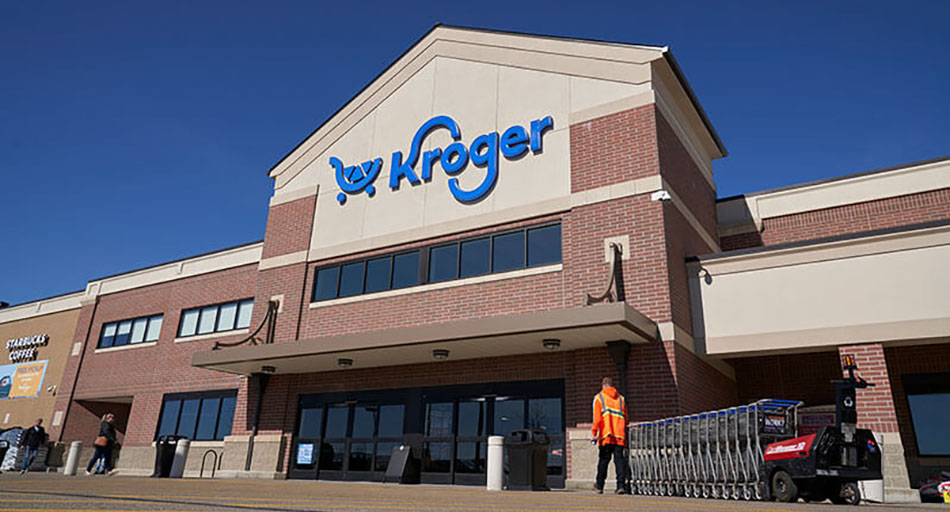
Texas has always been one of the most dynamic, competitive markets Kroger has competed in. To try and keep a competitive edge, the grocer focuses heavily on offering customers value and savings. Savings come in the form of extensive digital coupons, personalized offers, Fuel Rewards (including a variety of 4x gas points offers throughout the year) and weekly sales, among others.
The Kroger Texas Division comprises two division offices, in Dallas and Houston. As noted, the divisions merged last August to become one division – again. Kroger stores in Texas had operated under one Southwest Division until 2015, when the Dallas and Houston divisions became their own entities.
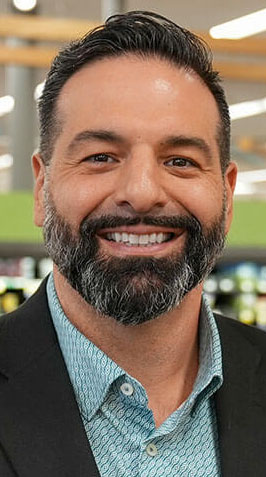
Kroger Texas President Rudy DiPietro explained some of the reasoning behind the divisions being separated back then. The Texas market was on a growth trajectory, and “they separated the divisions to, in a really smart way, create a little more intensity, kind of a growth dynamic in both markets.
“Both markets needed something a little different,” he added, based on their respective competitive sets and consumer preferences.
“I think it was done at the time to create more focus in each region and get kind of the growth engine moving. And that really worked.”
During those 10 years, a number of stores in both regions were developed, “and a lot of great work was done,” DiPietro said.
DiPietro took over as president of the Dallas Division on March 29, 2025, succeeding longtime Kroger veteran Keith Shoemaker, who was retiring. DiPietro had spent his 20-plus-year career with Ahold Delhaize U.S. banners before the move.
After DiPietro’s appointment, Houston Division President Laura Gump decided to retire after five years in the role and 38 years in the industry. At that point, the decision was made to bring the divisions back together, with DiPietro at the helm of the Kroger Texas Division, effective Aug. 1, 2025.
In addition to the retirements of the Texas division chiefs, some other factors played into the decision to bring the divisions back together, according to DiPietro.
“One, there’s a lot of talent in both places,” he said. “And as I started to spend time with folks, we could feel the opportunity for synergy where there was great thinking in one region around, say, a program or a product.
“There are so many incredible products that exist in both regions, and just the commingling of those products, you could just feel the financial potential that exists with both.”
Seeking best practices from each division would logically lead to operational efficiencies, finding the best go-to-market approach and discovering the best human resource practices.
“What we’ve really been doing over the last several months is evaluating those differences, kind of picking the best path and then starting to roll that path out,” DiPietro said.
Some differences are appropriate and will continue, he said, but “we will, over the next year, start to bring ourselves a little bit more into focus and get to one best practice that we’re executing across Texas and Louisiana.”
Kroger Texas maintains both the division offices today; “one division with two campuses,” as DiPietro describes it.
The Houston branch is located in Shenandoah, near The Woodlands, while the Dallas arm operates in the suburb of Coppell.
“We have executive presence in both places. We have incredible bench talent in both places, and we’ll continue to have that in both places,” he said. “We have a subset of us that go back and forth with incredible frequency.
“Our connectivity to both markets is really, I think, making an impact. As you start to get more North people with South orientation and knowledge, the synergy starts to ramp up.”
Today’s virtual tools also lend themselves to communication that’s almost like being there.
“We do this incredible meeting on Fridays with the entire group,” DiPietro said. “We get everybody on a call – store leaders all the way down to department leaders at store level. We can broadcast the message in an effective way today that maybe 10 years ago didn’t exist.
“The technology unlocks a lot for us from an efficiency standpoint and allows us to be all together when we can’t always be physically together,” he added.
Keepin’ it fresh
Kroger Texas keeps its store base fresh with new locations as well as refreshes of existing stores at seven- to nine-year intervals.
In 2025, new Marketplace stores in Plano and Fort Worth were opened, and ground was broken for three more – in Fort Worth, Little Elm and Anna.
The refreshes don’t take a backseat to new stores at all.
“While we are building a number of stores in Texas – and we’ll continue an aggressive capital new store strategy for us, which ranges around $40 million plus in terms of each individual project – that does not slow us down at all on our remodel schedule,” DiPietro said.
“This frequency of roughly 30-a-year remodels will continue to be our approach, because, once again, tethering back to that seven to nine years of life before you touch it, to do that and stay committed to that schedule is really going to be our path.
“Kroger is incredibly focused on Texas and understands the opportunity and also the challenge,” he said. “There’s quite a competitive set, and we have to keep modernizing if we want to win.”
In 2025, Kroger Texas completed 31 store refreshes, complete with 31 grand reopenings. 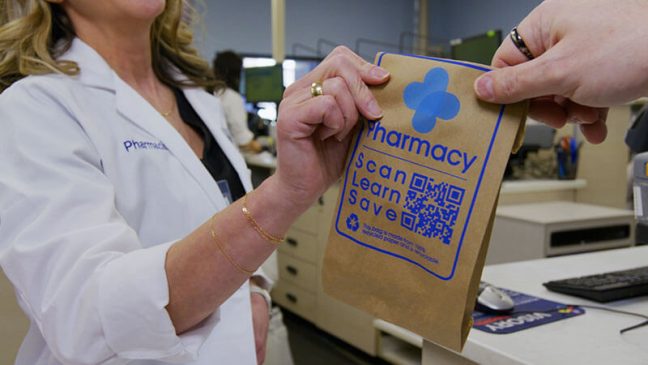
Products and services that are added during these refreshes depend on location, but can include technology upgrades, pharmacy services, fuel centers and e-commerce services such as pickup and delivery.
It might be freezer or refrigerated cases that better preserve the product or are more efficient or different shelving that provides a different angle of display. It also might be “improving the decor, the overall look and feel of the store, updating colors, updating messaging strategies, improving the assortment strategy in the store,” he said.
For associates, the remodel may bring new bathrooms and/or break rooms.
“All of those things are always in consideration, down to improved technology on the front end,” he said.
DiPietro added that if changes are needed between remodels, those are carried out as well.
A technology change that is launching in Texas Division stores is electronic shelf labels, which were tested in the company’s Louisville, Kentucky, division.
“We’re excited to take that pilot on in Texas and bring a different angle to our pricing and signing,” he said.
Speaking of signage, today’s technology offers opportunities for dynamic, rather than static, messaging. For instance, Kroger Texas could communicate with shoppers about its 70-plus years of serving the market, a new local product the store is carrying or other important information to share.
“We’ll start to invest in those things, but it’s really centered around customer experience, and it helps us improve the shopping experience,” DiPietro said.
Merchandising to the market
Though it’s fairly commonplace in grocery stores across the country today, Texas was one of Kroger’s first divisions to experiment with hyper-local merchandising back in 2009. Bringing the Dallas and Houston divisions back together last year just reinforced that path, with health and wellness alongside.
“The transformation of Texas from a market standpoint as one came with a pretty substantial reset of the team, and one of the areas where we’ve doubled down on focus is local, organic and natural,” DiPietro said. 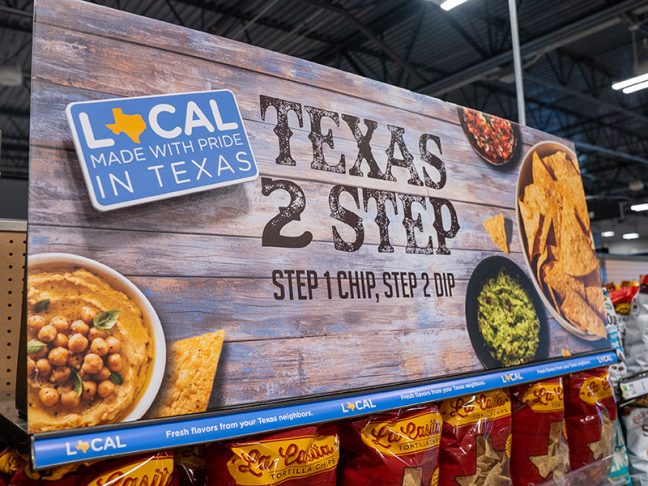
Calling local a “massive” focus, he said Kroger Texas has team members whose daily responsibilities are “foraging” for local partnerships, products and flavors.
“We think this can be a superpower for us,” DiPietro continued. “We put people behind it – great people – that are incredibly motivated, working with organizations like ‘Go Texan’ at the state level to help identify those products.”
Some Texas-made and hyperlocal Houston-made products include Mama La’s Kitchen, Guzel Cakes, Karbach Brewing and Antone’s Famous Po-Boys.
“We know in Texas – specifically and appropriately – there’s an immense amount of pride from being from the state, and our customer base wants to support local companies,” he added. “We think this is something we can take to a whole ’nother level.”
Products that have mass appeal across all the division’s stores in Texas and Louisiana are the first priority – “macro” opportunities, as DiPietro calls them.
Also lending to the local feel are partnerships with small Texas businesses that operate within certain stores that have excess foodservice space. In Houston, Burns Original BBQ operates within a Kroger store, while a high-end coffee café, Pax & Beneficia, was part of a new-build store in Fort Worth.
“We’re always looking for different opportunities,” said DiPietro, adding that it’s been hit-or-miss finding the right partners for these spaces. “If you can add it to a store and create draw, it’s a super positive for the community.”
The Texas Division also was one of the first for Kroger to introduce in-store Murray’s Cheese shops, a concept that originated in New York City, and Kroger Texas also is the birthplace of in-store sushi for the chain. It became a national success and now Kroger is the largest seller of sushi in the U.S.
Gone viral
In the polar opposite direction of local, the division also is alert to opportunities to bring in products from far away to set itself apart from the competition.
Kroger Texas stores were some of the first in the nation (and the first Kroger division) to carry a unique ice cream novelty from China. The product was a viral success, showing up on social media feeds.
DiPietro said the Texas Division’s data and learnings around “new and exciting” products are valuable to the company as a whole.
“From a population growth and from a diversity standpoint, this division is very unique to the enterprise,” he said. “There’s a handful of divisions across Kroger that have this profile where you can actually grow new stores, you have population growth, and that population growth is as diverse as we have here.
“When I talk to senior leadership at Kroger, they 100 percent see the opportunity and are excited to lean into it. We always say it’s a great responsibility. We should feel that responsibility and we should honor that responsibility and do good with it.”
Expanding Zero Hunger | Zero Waste reach
Efforts around Zero Hunger | Zero Waste continue to be an important component of Kroger divisions around the country, including Texas.
 Partnerships with Feeding America-affiliated food banks will continue to be vital to the efforts, but Kroger Texas is expanding its reach to “places where you wouldn’t expect food insecurity to necessarily be present,” DiPietro said.
One of those is college campuses. Kroger Texas has a “robust food pantry partnership” at the University of North Texas, he said, and a second was launched just a few months ago at the University of Houston, called the Cougar Pantry.
“Our ability to help funnel the right products through our partners is something we’re really proud of,” DiPietro said. “We have an opportunity to do more, but in the last year, we donated about 127 million meals in Texas, which is a mass effort, and something that we’re going to continue and find new ways to contribute.
“It’s always this balance between running a smart business model where you’re not wasting in an unneeded way but also finding a path to getting that food into the right hands when you can.”
[RELATED: The Past: 70 Years Strong, Kroger Texas Division Paves Path Of Progress]