
Minnesota’s grocery industry navigated significant challenges and changes in 2025, with new leadership at major chains, a cyberattack disrupting operations, federal SNAP funding uncertainty threatening rural stores and continued pressure from state labor mandates.
United Natural Foods Inc. (UNFI) appointed David Best as president and CEO of retail effective Aug. 17, leading the company’s two retail banners, Cub Foods and Shoppers Food Warehouse. Best, a Minnesota native, previously served as president and chief operating officer of St. Cloud-based Coborn’s Inc.

Best’s retail career includes 19 years with Minneapolis-based Target and a role as SVP of omnichannel and strategic capabilities for General Mills, whose headquarters are in Golden Valley
The leadership change came as UNFI’s retail division had recorded negative sales growth each quarter during the tenure of Best’s predecessor, Andre Persaud, who left after less than two years, according to The Star Tribune.
Best sat down for a “fireside chat” with UNFI CEO Sandy Douglas during the company’s Investor Day in New York City on Dec. 10.
A Minnesota native, Best oversees UNFI’s Shoppers Food stores on the East Coast as well as Cub Foods stores, which he calls his “hometown grocery store.”
Best said Cub is getting back to the ABCs:
- Anchor on the shopper;
- Bold and distinct assortment and merchandising; and
- Clear value.
“There’s magic when it all comes together,” he said, adding that Cub is a local, distinct retailer that can win in its markets.
A major element of winning, in both franchised and UNFI-owned Cub stores, are the people working in the store.
“We are a people business at its core. Team members need to be bold, make sure they’re curious – raise our bar every day – and be adaptable,” said Best.
He has hired four new senior-level merchandisers since joining UNFI to fine-tune product selections.
Douglas believes that Cub Foods stores could benefit from an improved natural/organic product mix, and Best says the company’s private brand staple items offer everyday value and need to be clearly merchandised. Proprietary brands include Field Day Organic, Essential Every Day and Wild Harvest.
Louis Martin, president of conventional grocery products and UNFI chief commercial officer, said each private brand serves a distinct purpose, from value to premium.
But knowing that innovation is important, Martin said UNFI is investing in private brand product reformulations and packaging redesigns to “bring modern relevance in every category.”
Cyberattack disrupts operations
In June, UNFI detected a cyberattack on its information technology systems that caused widespread disruptions across its distribution network and stores, according to regulatory filings with the U.S. Securities and Exchange Commission.
The attack, discovered June 5, forced the company to take parts of its network offline and left empty shelves at stores across the Twin Cities and nationwide, according to CBS Minnesota. Cub Foods pharmacies were particularly hard hit, with many unable to access prescription systems for several days.
UNFI, which distributes to more than 30,000 locations across North America, including Whole Foods, Kowalski’s and Lunds & Byerlys in Minnesota, said the cyberattack would cost at least $350 million in sales, according to KNSI News.
Gregory Esslinger, a distribution expert and former UNFI manager, told The Star Tribune the incident revealed “the fragility of our whole grocery system.”
Store openings
Cub Foods opened a new flagship store May 15 at 1750 County Road 42 in Burnsville, replacing the town’s previous location that closed in 2024. 
The store introduced Cub’s Shop Happy brand platform and features an updated layout, expanded produce section with more organic options and a modernized deli with additional grab-and-go meals and hot foods.
Other expanded departments include floral, bakery with custom cake decorating, seafood, meat, Kitchen Shop and Vitamin Shop. The store also has a drive-thru lane for online order pickup and a new pharmacy with drive-thru and walk-up options.
Aldi opened a new store Dec. 4 in Hibbing at 12060 Highway 169 West, marking the discount grocer’s expansion into northern Minnesota’s Iron Range, according to Bring Me The News. The store joins more than 80 other Aldi locations across Minnesota.
Coborn’s Inc. announced plans to build a prototype grocery and liquor store as part of The Boulevard development in Plymouth, marking the company’s debut in that market. The new store will focus on a wide assortment of fresh produce, locally grown products and meal solutions.
Major closures, acquisitions
Cub Foods closed its St. Paul Midway location at 1440 University Ave. West on Aug. 30, affecting 96 employees, according to MPR News. The closure leaves one major grocer, Target, in a stretch of University Avenue that a decade ago was home to four food stores.
The Midway Cub’s pharmacy closed Aug. 2, with prescription files transferred to the Cub Pharmacy in Roseville at 1201 Larpenteur Ave. West, according to KSMP News.
Cub Foods closed its Uptown Minneapolis location on Lagoon Avenue for renovations in June, according to Bring Me The News.
In July, Miner’s Inc. reached an agreement to purchase S&R Quisberg Inc.’s Cub Foods and Supervalu grocery stores in Baxter, Brainerd and Pequot Lakes. The Quisberg family, which operated retail grocery stores in the region since 1985, decided to retire from the grocery business.
As part of the agreement, the Baxter store closed in September. The Cub Foods in Brainerd and Supervalu store in Pequot Lakes were rebranded as Super One Foods. With the purchase, Miner’s owns and operates 33 retail grocery and 11 liquor stores across northern Minnesota, Wisconsin and Michigan.
In August, Hy-Vee withdrew from a planned Stillwater development after seven years of planning, according to the Twin Cities Pioneer Press. Despite the pullbacks, Hy-Vee maintains 41 stores in Minnesota and continues investing in technology, including a partnership with Grocery TV to install 10,000 screens in stores for marketing and messaging, according to the Minneapolis/St. Paul Business Journal.
Community support efforts
Cub Foods announced plans to contribute more than $200,000 during the 2025 holiday season in monetary and in-kind support to more than 50 Minnesota food banks and nonprofits.
During November and December, Cub donated approximately 1.5 million pounds of food to Minnesota families in need through its Food Rescue program.
Minnesota grocers faced uncertainty in November over federal the Supplemental Nutrition Assistance Program funding amid a government shutdown, creating concerns for rural stores that rely heavily on the program, according to MinnPost.
The National Grocers Association estimates about 12 percent of grocery and food retailer revenue comes from SNAP, according to MinnPost. Industry representatives report that 30-35 percent of business at many Minnesota stores comes from SNAP recipients, according to KCUR.
More than 440,000 adults, children, seniors, veterans, people with disabilities and others in Minnesota receive SNAP assistance to afford a basic diet, according to the Minnesota Budget Project.
Melissa Huberty, Stearns County’s human services administrator, told county commissioners in October that rural grocery stores in particular benefit from SNAP and would feel any changes.
Federal judges ordered the U.S. Department of Agriculture to tap into funding for the program during the shutdown, and the Trump administration said in November it would tap enough funds to cover half of November’s benefits, according to MinnPost.
Federal SNAP cuts
Congressional Republicans enacted significant SNAP cuts in legislation signed July 4, that the Minnesota Budget Project described as the largest reduction to food benefits for very low-income people in the program’s history. 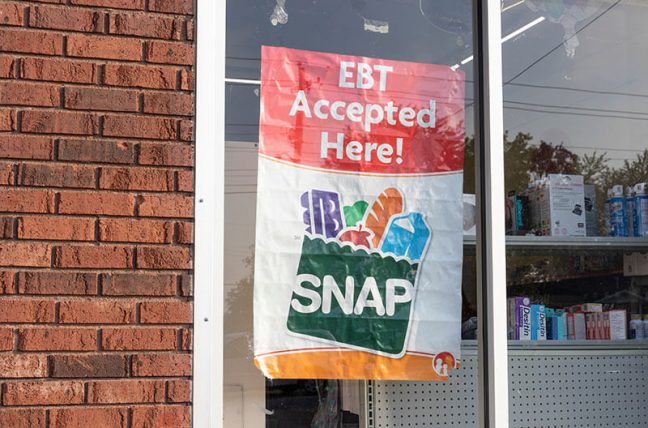
The changes included an unprecedented cost-sharing requirement forcing states to pay up to 15 percent of SNAP benefit costs based on payment error rates, according to the Minnesota Budget Project.
For Minnesota, this could cost more than $86 million annually when it takes effect in federal fiscal year 2028. The law also reduces federal administrative funding from 50 percent to 25 percent starting October 2026.
More than 63 percent of Minnesota SNAP participants are in families with children, and nearly two-thirds have incomes below the federal poverty level, according to the Minnesota Budget Project.
Rural grocery support programs
The University of Minnesota Extension’s Regional Sustainable Development Partnership has made rural grocery support a priority, conducting statewide surveys in 2015 and 2019-2020 to understand store owners’ needs, according to UMN Extension.
The program provides one-on-one technical support, connects stores to funding through the Good Food Access Program and offers produce handling workshops and energy audits. Survey results showed that 96 percent of rural store owners agreed that as small businesses, they have a responsibility to the wider community, according to UMN Extension.
Industry financial pressures
Minnesota grocers face the same thin margins plaguing the industry nationwide. FMI – The Food Industry Association reports that the average net profit for food retailers in 2024 was just 1.7 percent.
Traditional supermarkets compete not only with each other but with digital rivals, discount chains like Aldi and big-box retailers, including Target and Walmart.
Target ranks as the No. 1 grocer in the Twin Cities by market share, followed by Walmart, according to Axios and MinnPost.
[RELATED: Minnesota Retailers Face Mounting Pressures Despite Strength Of Independent Network]