
The grocery industry in Hawaii is facing mounting challenges as food insecurity remains high and transportation costs continue to climb.
Approximately 30 percent of Hawaii’s residents report some level of food insecurity, according to Alexis Chapman, director of operations for the Hawaii Food Industry Association in Honolulu. The situation is even more dire in certain areas.
“Some places on the Big Island, [food insecurity] is up to 40 percent,” Chapman noted, adding that current need levels match those seen “at the peak of the [COVID-19] pandemic.”

The crisis intensified during the recent federal government shutdown when Supplemental Nutrition Assistance Program benefits faced potential interruption. The association quickly mobilized to advocate for state intervention.
“When it looked like in late October that the SNAP payment for November was not going to happen, our executive director, Lauren Zirbel, and HFIA really led the charge in advocating for the state to step in,” Chapman said.
And it did. Gov. Josh Green got legislative approval to release emergency funds, ultimately putting $250 in state funds onto SNAP cards for Hawaii families prior to the federal SNAP benefits flowing again.
“SNAP users in Hawaii actually got a boost to their grocery budget, which was fantastic timing [with] the holidays coming up,” she said.
Chapman praised the Department of Human Services for its rapid response. “What an insane roller coaster ride that was the last week of October, first week of November. They were told, ‘We’re not going to fund SNAP.’ And then they got the funds. It was so amazing; DHS got the funds and they got them out on time.”
The SNAP crisis highlighted the program’s economic importance beyond individual food security. Chapman noted that SNAP purchases typically represent 9-14 percent of grocery retailer sales in Hawaii, with some staple goods manufacturers reporting figures as high as 20 percent of sales. SNAP funds coming into Hawaii are about $58 million.
“SNAP has a really big economic multiplier effect, because it goes into communities that are lower income, and it goes into businesses that provide jobs and services in those communities. It’s a really valuable program not just for users but for everybody,” she said.
According to Chapman, the federal government shutdown emphasized the reality that “the state is the first line of defense against food insecurity. There is an opportunity here for the state to step up and say, ‘We’re going to do what we can about this. We’re going to take action to make food more affordable for Hawaii residents in Hawaii and not just rely on federal aid for that.’ Maybe there’s kind of an opportunity here to look at this a different way.”
Hawaii grocers demonstrated adaptability during the uncertainty. Because of how long it takes for food to be delivered, they had already placed orders for November and shipments were on the way when the SNAP situation emerged.
“They really had to be super adaptable and super flexible to make sure that they could continue to serve their customers and serve the community in the face of all this uncertainty,” Chapman said. “Our retailers, our members, just did a fantastic job of figuring out how to make sure that they were stocked and staffed appropriately, even on really short notice.”
Shipping fees going up
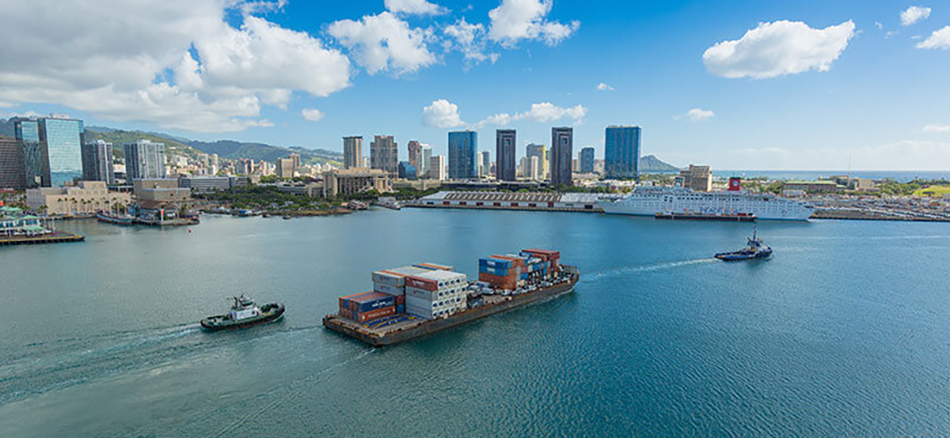
Adding to the industry’s challenges, Hawaii’s interisland barge company has been approved for a 25 percent rate hike.
On Nov. 17, the Hawaii Public Utilities Commission approved the new rates for Young Brothers, which go into effect Jan. 1. According to a press release, this is the first permanent adjustment in more than five years and “reflects the commission’s review of rising costs, lower cargo volumes and $120 million invested in maintaining safe and reliable statewide service.”
Frank Almaraz, interim president of Young Brothers, said, “We appreciate the commission’s decision and view this as an important first step toward addressing the financial strain created by years of rising costs and delayed rate updates. These new rates address our most immediate financial solvency risk by better aligning customer rates with the costs to provide and maintain reliable service across every island.”
Chapman noted that Young Brothers, an HFIA member, is “a very important partner for the industry to get food and agricultural products from the neighbor islands around to Honolulu and everywhere,” adding that products that are shipped into the state from outside are shipped by Young Brothers to the neighbor islands.
“So when they do have a rate increase, it can have pretty wide-reaching impacts; [it] definitely will impact food prices on the neighbor islands,” she continued. “We understand there’s sometimes need for rate hikes, so we’re going to try and work with all stakeholders to try and minimize negative impacts of this.”
Added pressures
The transportation cost increase comes as the industry grapples with other economic pressures, including federal tariffs that have affected both imported food and equipment costs. Chapman noted that for small manufacturers, “a machine that they need to manufacture going up in price by 20 percent or 30 percent really can be pretty detrimental.”
Hawaii’s ongoing workforce shortage exacerbates these challenges, creating what Chapman described as “a feedback loop of economic challenges” where residents leaving due to high costs contribute to labor shortages, which in turn drive prices higher.
The HFIA is pushing for long-term solutions, including legislation to gradually eliminate the state’s general excise tax on groceries. Hawaii remains one of the few states that taxes groceries, with a rate of 4.75 percent.
“Getting that off would lower the cost of food, and that would just benefit everybody, but most especially our lower-income families, our working families,” Chapman said.
The organization also advocates for increased funding for the Double Up Food Bucks program, which allows SNAP recipients to get twice as much produce when using their benefits. “Da Bux,” the program’s nickname, benefits local agriculture, SNAP users and retailers simultaneously, she said. This initiative has become more critical as federal agricultural funding has been cut across the country, including Hawaii.
[RELATED: Okimoto Corp.’s Longstanding Values Guide Everyday Operations Of Its Stores]