
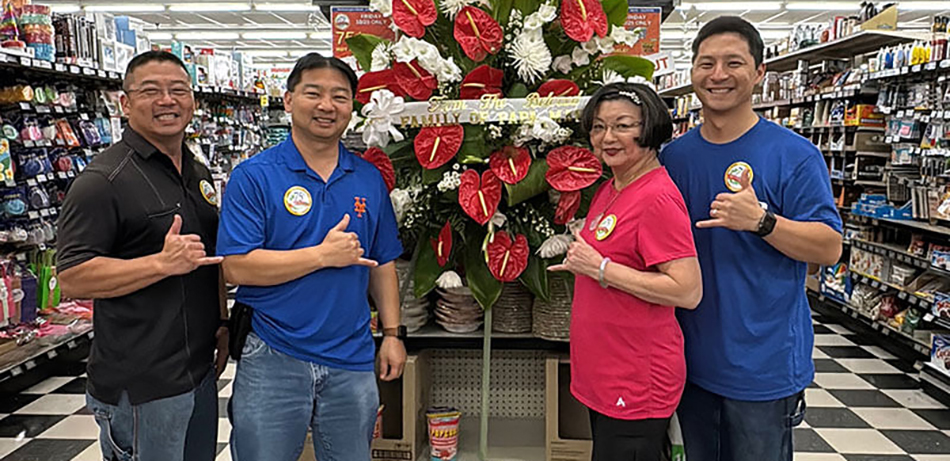
Hawaii grocer Okimoto Corp. celebrated 75 years in business in 2024, built on a foundation of honesty, integrity, humility and unity. Led by the third generation – Kris, Kyle and Kit Okimoto – the company operates two stores on Oahu and one on Molokai.
Kit Okimoto, who in addition to his CFO duties in the family business is serving as chairman of the Hawaii Food Industry Association, took time out of the busy holiday season to correspond with The Shelby Report’s Lorrie Griffith.
Tell me about each of your stores – the two your company opened and the one you acquired on Molokai. Anything that differentiates the three stores from each other? Being on two different islands, do some of the markets they serve differ as well?
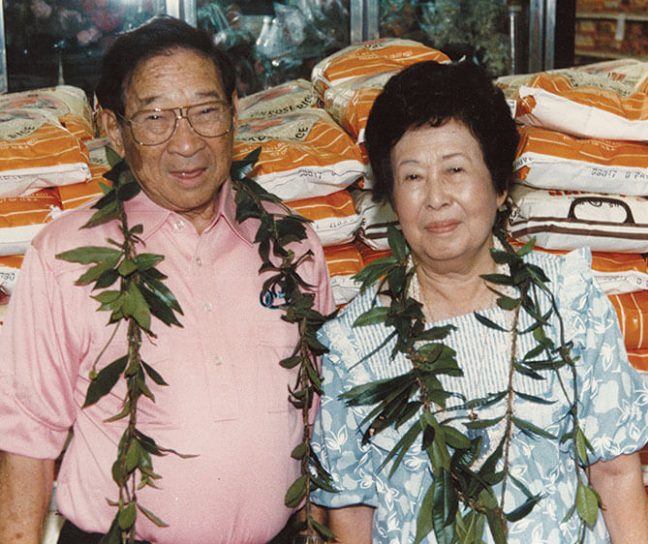
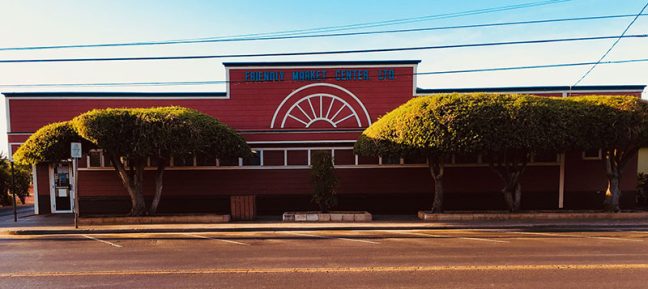
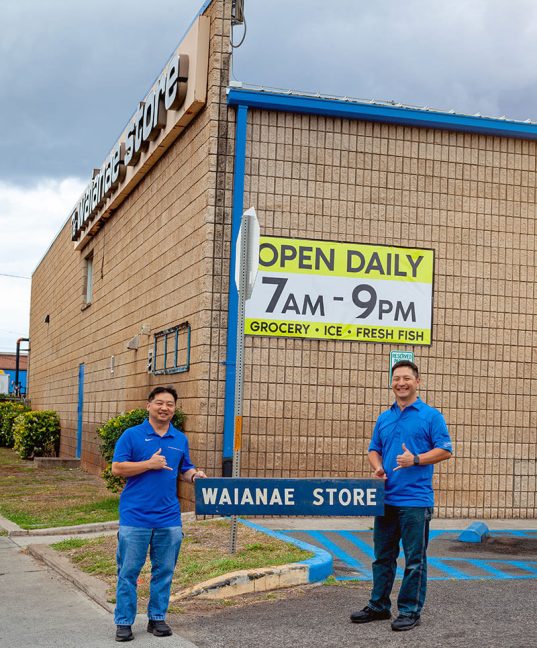
We have three stores, all under different names. The Waianae Store is our original store, and our grandparents, David and Betty Okimoto, opened it in 1949. Nanakuli Super opened five miles down the road in 1973. We acquired Friendly Market Center on the island of Molokai in 2017; that store was started by the Egusa family in 1953.
We are traditional full-service grocery stores that act as general stores, and our buildings range from 5,000-18,000 square feet.
Waianae and Nanakuli are in the rural part of Oahu, and Molokai is a neighbor island with a small population, so even though we’re interisland, our markets are fairly similar. Hawaii being Hawaii, a lot of our employees and customers have family and friends in both areas.
What would you say your stores are known for among shoppers – signature deli/bakery/prepared food items, meat/seafood, produce, customer service, charitable giving, etc.? Are you known for your poke? (I hear grocery stores are where you should buy your poke when you visit the islands!)
We take pride in our excellent customer service, and we treat everyone like family. We do our best to spread Aloha, and it makes for the best shopping experience.
One of the former owners of Friendly Market put up a sign a long time ago, and it emphasizes how everyone plays a part in a great customer experience, including the customers: “Aloha spirit required here. If you can’t share it today, please visit us some other time. Mahalo.”
We’re known for our fresh ahi poke and dried aku, along with our fresh produce, and brownies from our in-store bakery are a customer favorite!
Okimoto Corp. is now in its third generation of family leadership. What are some of the keys to continuing success for your family business?
Our people are everything to us, and we do our best to retain them. We’re very fortunate to have many experienced and tenured employees, and they are the backbone of our company.
We simply would not have a business to perpetuate without maintaining continuity within our ranks. Our company values of honesty, integrity, humility and unity keep us focused and grounded day to day and year to year.
We have about 180 employees total companywide. We teach that everyone in every department plays a role in excellent customer service, and our management team is great at emphasizing this.
We always have our eye on the future, and younger team members are of course an important part of continuity. While we realize not everyone will stay with us forever, we treat them like they will.
You and your brothers Kyle and Kris run the business together. Tell me about your different duties and how you complement each other in your roles.
Kyle is the CEO, and he handles personnel and HR. Kris is the COO, and he takes care of facilities and maintenance. I’m the CFO, and I’m responsible for sales and finance.
Really what it comes down to is three heads are better than one, and we work together well. Because if we didn’t, we wouldn’t be good stewards of the company.
When you do have differences of opinion with your brothers, how are you able to work through that? Is there a fourth generation up and coming?
We knew the family part is always more challenging than the business part of a family business, so we set out from the beginning to maintain that it’s always family first and business second. It’s impossible to fully decouple the two. But keeping this in mind helps us try to keep the business part just that.
The next generation is growing up fast, but no commitments so far. There’s no expectation on our part that any of our kids will run the business though. If it ends up that way, it needs to be because they want to.
What role does technology play in your operations? If different across your stores, please elaborate.
We’re by no means the industry leader in technology, but we do our best to stay close to the forefront and evaluate what can be a good fit. That can be especially difficult being all the way in Hawaii, so we make the best of every opportunity to connect with grocers everywhere.
We’re too small to pour a lot of capital into a project that could sink us if it’s unsuccessful, so we carefully think through potential improvements as much as possible.
Satisfying our customers is always the goal, so whether we’re upgrading software or adding new hardware like self-checkouts or ESLs, new technology must improve the customer experience.
Any planned stores or remodels?
None that I’m aware of at the moment, but we’ve learned to never say never.
Grocers are known for supporting their communities. Tell me about some of Okimoto Corp.’s priorities in its giving.
Like most independents, we support our communities in lots of ways but don’t do a great job advertising it. The support itself is what’s important, so that’s where we focus our efforts.
Our local schools are our priority, so we support them in any way we can. There are a lot of other worthy causes, but since we can’t support every organization, we focus on non-profits and projects that tend to benefit our community as a whole.
We also started working with the blood bank and are hosting blood drives in memory of our dad, Ken. Additionally, we’re Adopt-a-Highway stewards on both islands.
You face unique challenges as a grocer in Hawaii, including high levels of food insecurity, high shipping costs, supply chain issues, etc. What are some of those and how does Okimoto Corp. creatively meet those challenges?
The cost of living in Hawaii creates worrisome levels of food insecurity. We are fortunate to be participating stores in the Da Bux Double Up Food Bucks program administered by The Food Basket [the island of Hawai’i’s food bank]. This program allows SNAP recipients to save 50 percent on local produce, so it goes a long way in helping some of our most food-insecure customers.
Our food supply chain in Hawaii is delicate since the vast majority of our food is imported. Even a brief shipping disruption or product shortage can have lasting effects. Like many independents in Hawaii, we have larger than normal warehouses, so we’re able to hold onto a little more inventory than other stores. It comes at a cost, but it’s necessary to help keep our community fed.
Shipping costs are high and are continuing to escalate, particularly for the neighbor islands. Short of buying our own vessel there’s not a lot more we can control logistically, but we are constantly working with our vendors and looking for new ones so we can help keep costs down as much as possible.
We buy direct from some manufacturers to support these efforts, and that’s where our warehouses come into play.
Okimoto has been a supporter of the Hawaii Food Industry Association from the start. What are you hoping to accomplish during your time as chairman? What does it mean to you to serve in that role?
It’s truly an honor for our company to be at the head of the Hawaii Food Industry Association this year. We’re a small independent, and that we have a seat at the table is humbling.
My goal is to make sure that our members, especially our retailers, value and get value out of their membership in HFIA as we fulfill our mission to promote the strength, sustainability and resilience of the food industry in Hawaii. That starts with listening, and I hope to talk with as many people as I can to see how we can better serve.
I really appreciate the transparency here. It makes total sense. when you’re operating in Hawaii, you don’t have the luxury of ‘trial and error’ with tech that isn’t backed by reliable support. I specifically noted your point about only investing in what improves the customer experience. We’re not interested in ‘tech for tech’s sake’ either, our goal is to provide a solution that feels like a safe, high-impact bet for a team of your size. We’d love to show you how we prioritize that ROI and ensure the transition is seamless, despite the distance.