
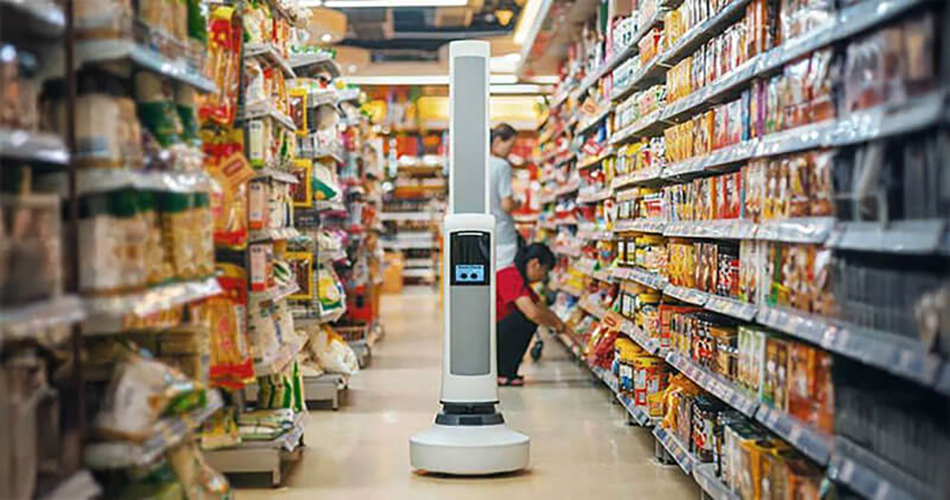
In a recent interview with The Shelby Report, South San Francisco-based Simbe highlighted how its autonomous retail intelligence solutions address critical inventory and operational challenges facing grocers.
Simbe describes itself as the global leader in retail shelf digitization and combines artificial intelligence with robotics to provide retailers with real-time insights into store operations. The company offers its Store Intelligence Platform, with Tally as its flagship product. Tally was the world’s first an autonomous robot about 10 years ago.

“It goes up and down aisles, and it scans price tags as well as item availability,” said Caitlin Allen, SVP of market at Simbe.
According to the company, Tally uses computer vision to identify product locations, out-of-stock items and pricing information with 99-percent accuracy. The robot operates autonomously during store hours alongside shoppers and employees, auditing shelves for inventory issues.
Allen emphasized the scale of the inventory problem facing retailers and consumers.
“What you probably know as a consumer is that one of every five items that we go to the store wanting to get aren’t on the shelf, and about one of every two items that we order online are delivered with substitution or not delivered at all because they’re not found in the store,” Allen said.
The technology also addresses a workforce challenge. Allen said manual product checking is among the most disliked tasks for store associates.
“With the robot, they’re able to take that off of their plates. It’s also the thing that they hate the most. It’s the No. 1 reason that they quit – monotonous tasks,” Allen said.
Simbe’s retail partners include BJ’s Wholesale Club, Wakefern, Schnuck Markets, SpartanNash, Albertsons and Carrefour, among others across the U.S., Europe and Asia.
“We power the most retail banners of any vendor in our space in the world. We’re basically almost 40 in 10 countries, and more than half of U.S. states,” Allen said.
The platform includes Tally and Tally Spot, a fixed camera sensor, among other products. Allen said the technology provides visibility into shopper behavior at the critical moment of purchase decision.
“Our view is that in retail, 98 percent of commerce happens in the store. In retail, with point-of-sale data, supply chain data and the data we get from our consumer applications, we get a lot of interesting and amazing and important insights. What’s missing is visibility into what happens at that moment at the shelf when a shopper [decides] what to buy or not,” Allen said.
“With our platform, including Tally and then this fixed-camera sensor, Tally Spot, and there’s a few others, what retailers are able to do is see exactly what happens at that moment, and it varies with what the use case is, whether it’s the store operations team or a merchandising team,” Allen said.
The company recently announced Simbe for Merchants, a suite of tools designed for merchandising teams. Allen said shelf digitization should precede other store technology investments.
“Our view is that’s the place to start. If you’re going to invest in ESLs, you need to actually know where your items are located before you invest in digitizing the price tag.”